wrestling
The Akhada's Unbroken Lineage
Gold medals for Sagar Jaglan and Kajal Dhochak at the Ulaanbaatar Open are a monument not to federation support but to the decentralized akhada system that keeps producing Indian wrestling champions despite it.
By Meera Chandrasekaran, Wrestling & Combat Sports · June 18, 2026 · 6 min read
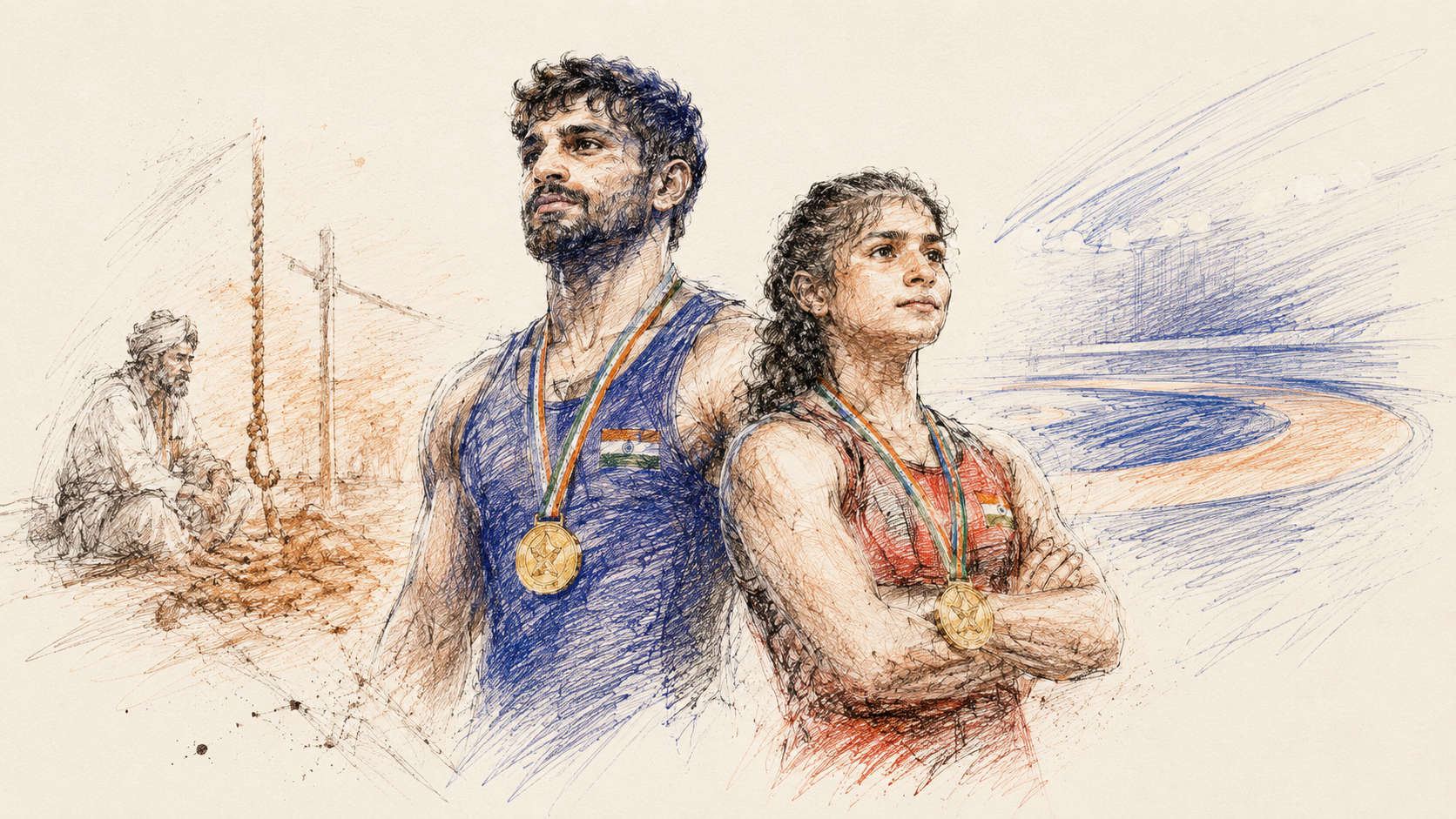
Illustrated portraits of two Indian wrestlers wearing gold medals, with a traditional akhada training scene in the background
ULAANBAATAR — The Buyant-Ukhaa Sport Palace in the Mongolian capital is a sterile, cavernous amphitheater of synthetic rubber, blinding halogen lights, and the piercing, digitized squeal of the referee’s whistle. It is an environment engineered for absolute, friction-less athletic execution. Yet, when India’s Sagar Jaglan and teenager Kajal Dhochak stood atop the podium at the Ulaanbaatar Open in early June, with gold medals draped heavily around their necks, their victories were not born in this immaculate arena.
Their triumphs were forged thousands of miles away, in the humid, dimly lit, earth-scented akhadas of Haryana—spaces that operate on a physical and institutional logic entirely antithetical to modern Olympic sports science.
The dual golds in Mongolia represent far more than a successful weekend for the Indian freestyle wrestling contingent. They stand as a visceral, defiant testament to a decentralized, ancient sporting architecture. Over the past three years, the formal superstructure of Indian wrestling has endured catastrophic institutional trauma. The national federation has been paralyzed by bureaucratic chaos, suspended by global governing bodies, and defined by the haunting images of elite athletes staging sit-in protests on the asphalt of New Delhi.
By every law of modern high-performance sports management, a system enduring this level of administrative atrophy should collapse. The talent pipeline should dry up. The medals should stop.
Yet, the Indian wrestler continues to win. Jaglan and Dhochak’s dominance in Ulaanbaatar forces us to confront a fascinating, deeply uncomfortable truth about the country’s sporting ecosystem: India’s wrestling excellence survives not because of the national system, but in sheer, stubborn defiance of it. It survives because of the dirt.
The Atrophy of the State and the Survival of the Lineage
In the West, elite wrestling is an institutionally tethered endeavor. It relies on the hyper-structured pipelines of the NCAA in the United States or the monolithic, state-funded academies of Eastern Europe. If the central funding stops, the program dies.
In the agrarian belts of Haryana, wrestling is not a program; it is a monastic lineage. The akhada (the traditional wrestling ground) operates independently of state sanction. It is governed by the Guru-shishya parampara—an unbroken, master-to-disciple transmission of biomechanical knowledge and psychological hardening. When the national federation in New Delhi collapsed into factional infighting, the daily rhythms of the akhada did not alter by a single second. The soil was still tilled at 4:00 AM. The ropes were still climbed. The hundreds of Hindu push-ups (dands) were still executed in monastic silence.
This extreme decentralization acts as an unbreakable blockchain of wrestling knowledge. A bureaucrat in a capital city cannot shut down an akhada because the akhada relies on local agrarian patronage, not federal grants. Jaglan and Dhochak did not emerge from a sterilized, state-of-the-art high-performance center; they are the products of an autonomous ecosystem that views bureaucratic chaos as a mere distraction from the brutal reality of the mat.
The Biomechanics of the Mitti
To truly understand why the Indian wrestler is so uniquely formidable on the international stage, one must analyze the foundational physics of their origin. Long before they step onto the high-density EVA foam of an Olympic-regulation mat, athletes like Jaglan and Dhochak spend years warring in the mitti—the traditional clay pits of the akhada.
The mitti is not just a surface; it is an active, antagonistic variable. The earth is meticulously prepared, often mixed with mustard oil, buttermilk, and red clay. From a biomechanical perspective, this creates a highly yielding, inelastic surface.
When a wrestler attempts an explosive takedown on a synthetic international mat, the foam returns a significant percentage of their kinetic energy. The mat is springy; it aids velocity. The mitti, conversely, absorbs and dissipates energy completely. It is a metabolic black hole. Every movement in the mud requires a pure, unassisted concentric muscle contraction. To execute a dhobi paat (shoulder throw) in yielding clay, the wrestler must generate twice the baseline torque required on rubber, utilizing profound isometric strength just to maintain their footing.
Furthermore, wrestling in the mitti fundamentally rewrites an athlete's proprioception (the body's ability to sense its location, movements, and actions). Because the mud severely limits footwork and agility, mitti wrestling is heavily reliant on upper-body clinching, pummeling, and unbreakable grip strength.
When a wrestler like Jaglan transitions from the suffocating friction of the mud to the frictionless speed of the Ulaanbaatar mat, a terrifying physical alchemy occurs. The isometric power developed in the clay translates into explosive, devastating velocity on the synthetic rubber. They step onto the mat feeling lighter, faster, and unburdened by gravity. They are athletes who have spent their entire lives training with a physical handicap, suddenly unleashed in a vacuum.
The Crucible of the Female Phenom
If Jaglan’s victory is a testament to the biomechanical superiority of the akhada, Kajal Dhochak’s gold medal is a monument to its grudging, yet profound, sociological evolution.
For centuries, the akhada was a fiercely guarded, hyper-masculine sanctuary. The introduction of female athletes into these spaces was not a seamless integration; it was a societal collision. Women stepping onto the mitti were fighting a two-front war: battling the opponent across from them, while simultaneously dismantling the deeply entrenched patriarchal friction of their own villages.
Dhochak belongs to a generation of young women who no longer have to beg for space in the dirt. But she inherits the psychological armor of the women who fought those initial battles. To survive the akhada as a teenager requires a psychological architecture built of iron. The training is unapologetically brutal, entirely devoid of the softer, "load-managed" approaches favored by Western sports psychologists.
When Dhochak stared down her opponents in Mongolia, she carried an intimidating, localized ferocity. In the closing minutes of a tight match, when lungs burn and the blood's lactic acid concentration reaches paralyzing levels, the athlete who prevails is the one whose baseline for suffering is highest. For an Indian woman forged in a rural akhada, the suffering of a six-minute wrestling match is entirely manageable compared to the societal gravity she has already defied just to stand on the mat.
The Unbreakable Chain
As the Indian national anthem echoed through the Buyant-Ukhaa Sport Palace, the executives and bureaucrats in New Delhi undoubtedly rushed to draft press releases claiming a piece of the glory. It is the predictable reflex of a broken system desperate for validation.
But the medals won by Sagar Jaglan and Kajal Dhochak do not belong to the federation. They belong to the soil.
Wrestling is a sport of pure, unadulterated truth. You cannot lobby your way out of a headlock. You cannot rely on a teammate to cover your blown assignment. When the whistle blows, you are entirely alone with the physical and mental architecture you have built.
India’s continued dominance in this ancient, violent art form proves that while administrative systems can rot, decay, and collapse, a true lineage cannot be legislated out of existence. As long as the earth in Haryana is tilled before dawn, as long as the gurus continue to pass their silent, grueling knowledge down to the next generation of broad-shouldered boys and iron-willed girls, the Indian wrestler will remain inevitable. The system may be broken, but the akhada remains unbroken.
Part of Issue 1: The Long Game, published June 18, 2026→