womens-football
The Golden Cage: Why India's SAFF Triumph Must Be the Floor, Not the Ceiling
India's women scored 18 goals and conceded one en route to a sixth SAFF Championship — a dominant campaign that also exposes how shallow the South Asian competition actually is.
By Ananya Pillai, Football · June 18, 2026 · 7 min read
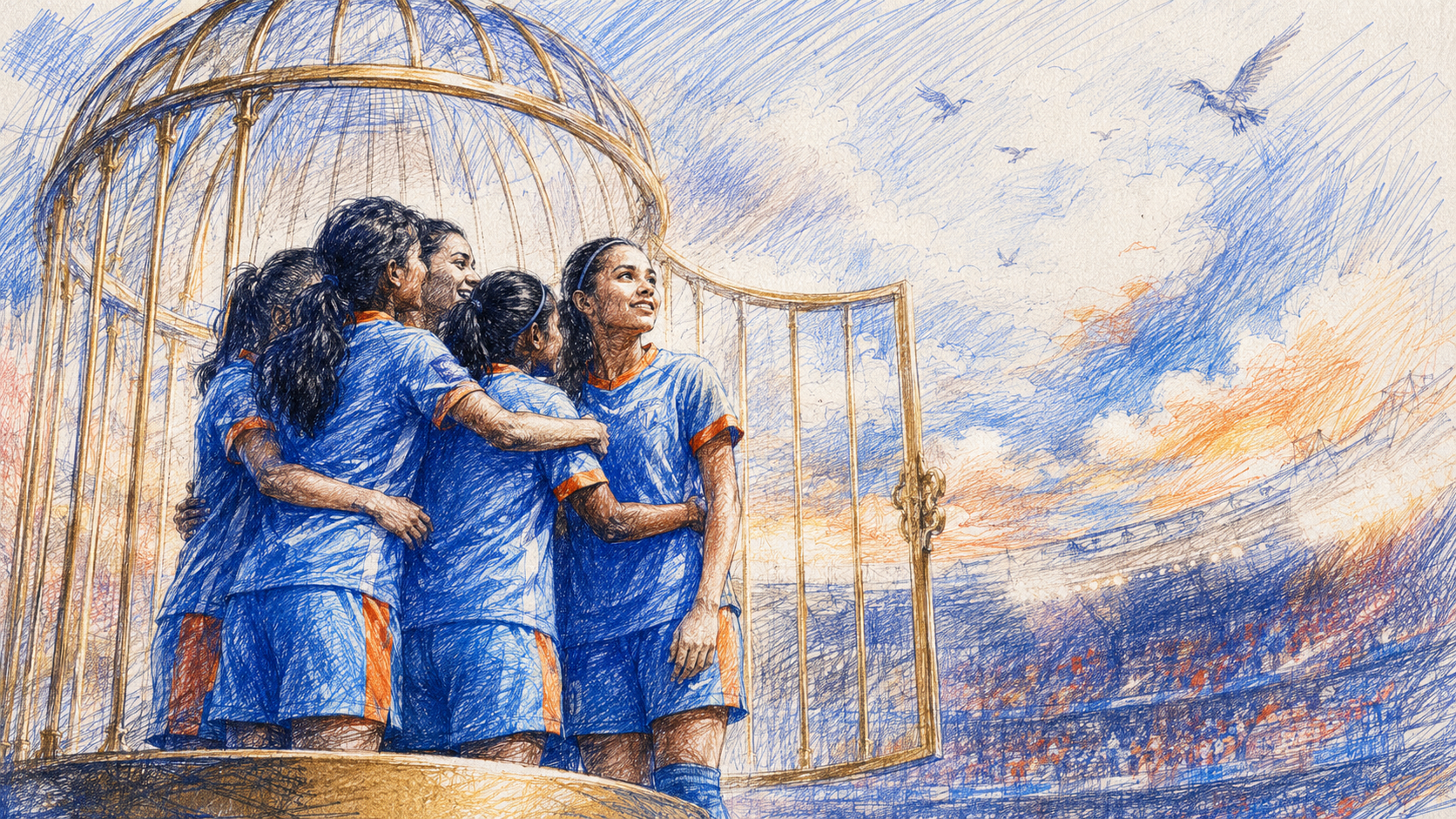
Illustration of India's women's football team embracing inside an open golden birdcage, looking out toward a stadium crowd
MARGAO, Goa — The roar that ripped through the Pandit Jawaharlal Nehru Stadium on Saturday night was not the sound of a revolution; it was the heavy, collective exhale of a natural order being restored. When Lynda Kom Serto capitalized on a catastrophic defensive error in the 82nd minute, stabbing the ball into the net to seal a 3-1 victory over Bangladesh, she did more than secure India’s record-extending sixth SAFF Women’s Championship. She temporarily silenced the anxieties of a nation’s footballing ecosystem, exorcising the ghosts of a frustrating seven-year interregnum during which the "Blue Tigresses" watched their neighbors usurp the South Asian throne.
The post-match celebrations in Goa were visceral and completely justified. Head coach Crispin Chettri’s squad operated with a ruthless, clinical efficiency throughout the tournament. Pyari Xaxa’s scrappy but opportunistic opening goal in the 42nd minute broke the initial deadlock, and Sanfida Nongrum’s precise header mere seconds into the second half effectively broke the opposition's psychological resolve. Defensively, India was an iron wall, yielding only a single, spectacular long-range strike from Bangladesh’s Ritu Porna Chakma over the entire campaign.
India scored 18 goals in this tournament. They conceded exactly one. By every conceivable metric of the South Asian Football Federation, the campaign was a masterclass in regional hegemony.
But as the confetti settles on the Margao turf and the All India Football Federation (AIFF) prepares to parade this trophy, a deeply uncomfortable truth must be confronted: South Asia is a golden cage.
In the ruthless, hyper-analytical lexicon of global soccer, dominance is entirely relative. To reign supreme over the SAFF region—a confederation where no single nation currently ranks inside the FIFA top 60—is to be the apex predator of a remarkably shallow pond. The true danger of Saturday’s euphoric victory lies not in the achievement itself, but in the institutional complacency and tactical illusions it so reliably breeds.
The Mathematics of Stagnation
Historically, Indian football has possessed a fatal habit of treating regional supremacy as an ultimate destination rather than a developmental waypoint. This is a systemic failure of ambition. When a national team routinely demolishes Maldives 11-0 in the group stages, or comfortably handles Bhutan without ever shifting out of second gear, the profound structural deficiencies that plague the domestic game are temporarily papered over by the sheer volume of goals.
The FIFA coefficient system is brutally honest about this disparity. While India hovers in the upper 60s of the global rankings, the majority of their SAFF opponents languish outside the top 100. Playing in this environment creates a dangerous positive feedback loop of false tactical security.
In these regional fixtures, India is almost never punished for transitional errors. A misplaced pass in the midfield pivot against Nepal or Sri Lanka might result in a broken play; the exact same error against Japan or Australia results in a goal within six seconds. The SAFF Championship does not test India's true structural integrity because the opposition lacks the athletic and technical capacity to exploit the micro-fractures in Chettri’s system.
The Illusion of Positional Play
To understand the tactical trap of the SAFF region, one must look at the biomechanics and spatial dynamics of the matches themselves. Against South Asian opposition, India enjoys a monopoly on ball possession, often commanding upwards of 65 to 70 percent. Opposing teams immediately drop into a deep, compact low block, parking two banks of four strictly behind the ball, hoping to survive the full 90 minutes and perhaps steal a 1-0 victory on a counter-attack.
Consequently, India spends the majority of these matches camped in the attacking third, practicing how to pick the lock of a defensive bunker. They rely on the individual brilliance of players like Sanfida Nongrum and the sheer physical superiority of their wingers to bypass fullbacks.
However, this entirely inverts the tactical reality India faces when they step onto the continental stage.
We have seen this grim cycle repeat itself. India won five consecutive SAFF titles between 2010 and 2019, seemingly invincible at home. Yet, when they stepped outside the subcontinent to face the heavyweights of the AFC—or even mid-tier ascending powers like Vietnam and the Philippines—the gulf in tactical sophistication, physical conditioning, and speed of thought was jarring.
Against elite Asian teams, India is the team forced into a desperate low block. Suddenly, the Blue Tigresses are starved of possession. They are forced to defend complex, asymmetrical pressing triggers and intricate combinations in the half-spaces—tactical concepts they rarely encounter, let alone master, within their own regional bubble. Because they spend their SAFF campaigns operating as the aggressor, they lack the deeply ingrained defensive periodicity and rapid transitional speed required to survive against teams that press them into submission.
The Tactical Periodicity Deficit
The root of this continental vulnerability does not lie with the players' intrinsic talent. Players like Pyari Xaxa possess the technical acumen, attacking instincts, and raw athleticism to trouble defenses far beyond the borders of South Asia. The failure is systemic, rooted deeply in the architecture of the domestic calendar.
Elite football is governed by the concept of tactical periodicity—the meticulous, year-round structuring of physical, technical, and psychological stimuli to ensure players peak at the right moments while maintaining a consistently high baseline of performance. In Europe and East Asia, female professionals endure grueling, nine-to-ten-month domestic leagues, facing high-leverage, physically exhausting situations on a weekly basis. Their bodies and minds are forged in a continuous crucible.
By contrast, the Indian Women's League (IWL), despite recent expansions and a shift to a home-and-away format, remains fundamentally brief. A fourteen-match season played over a few months simply cannot replicate the physiological adaptations required for elite global football. When the domestic league ends, the players are thrust into a competitive vacuum.
Talent without the relentless forge of elite, sustained competition is a depreciating asset. You cannot build the aerobic capacity or the high-speed decision-making required to beat South Korea by playing a handful of league games and relying on month-long national team camps. The AIFF’s reliance on isolated national camps to build fitness is an antiquated model; fitness and tactical sharpness must be the byproduct of a rigorous, year-round domestic league, not a crash course administered weeks before a tournament.
Breaking the Iron Bars
If India genuinely harbors ambitions of qualifying for a FIFA Women's World Cup, or even making a sustained, deep run into the knockout stages of the AFC Women's Asian Cup, the blueprint must fundamentally change on Monday morning.
The AIFF must formally recognize that the SAFF Championship is the absolute floor of their ambition, not the ceiling. Winning it should be an expectation, a procedural formality, not the culmination of a four-year developmental cycle.
Breaking out of the golden cage requires a masochistic scheduling philosophy. India must aggressively seek out international friendlies against opposition that will humiliate them. They need to play teams ranked in the top 30—teams that will press the Indian backline into panicked turnovers, expose the midfielders' inability to turn in tight pockets of space, and ruthlessly punish every momentary lapse in concentration.
There is a psychological toll to losing 4-0 to Japan or Australia, but it is a necessary crucible. Growth only occurs at the absolute edges of failure. As long as India continues to schedule friendlies against teams they know they can beat, they are actively choosing the comfort of the cage over the bruising reality of the wild.
Furthermore, the IWL must be aggressively expanded, heavily capitalized, and extended into a true year-round professional enterprise. Clubs must be mandated to maintain elite sports science departments, ensuring players are monitored for load management and force development twelve months a year.
As the stadium lights dimmed in Margao and the crowds filtered out into the humid Goan night, the Indian women's team deserved every ounce of their celebration. They did exactly what was asked of them. They are the undisputed, unchallenged queens of South Asia once again.
But tomorrow, the real work begins. Now comes the hard part: packing up the crown, leaving the comforting warmth of the neighborhood, and finally picking a fight with the rest of the world.
Part of Issue 1: The Long Game, published June 18, 2026→