karate
Codified Combat: The Export of Indian Striking to the Global Tatami
A bronze medal in Tbilisi marks the moment Indian karate stopped fighting the WKF's Euro-centric judging bias and started speaking its language instead.
By Meera Chandrasekaran, Wrestling & Combat Sports · June 25, 2026 · 7 min read
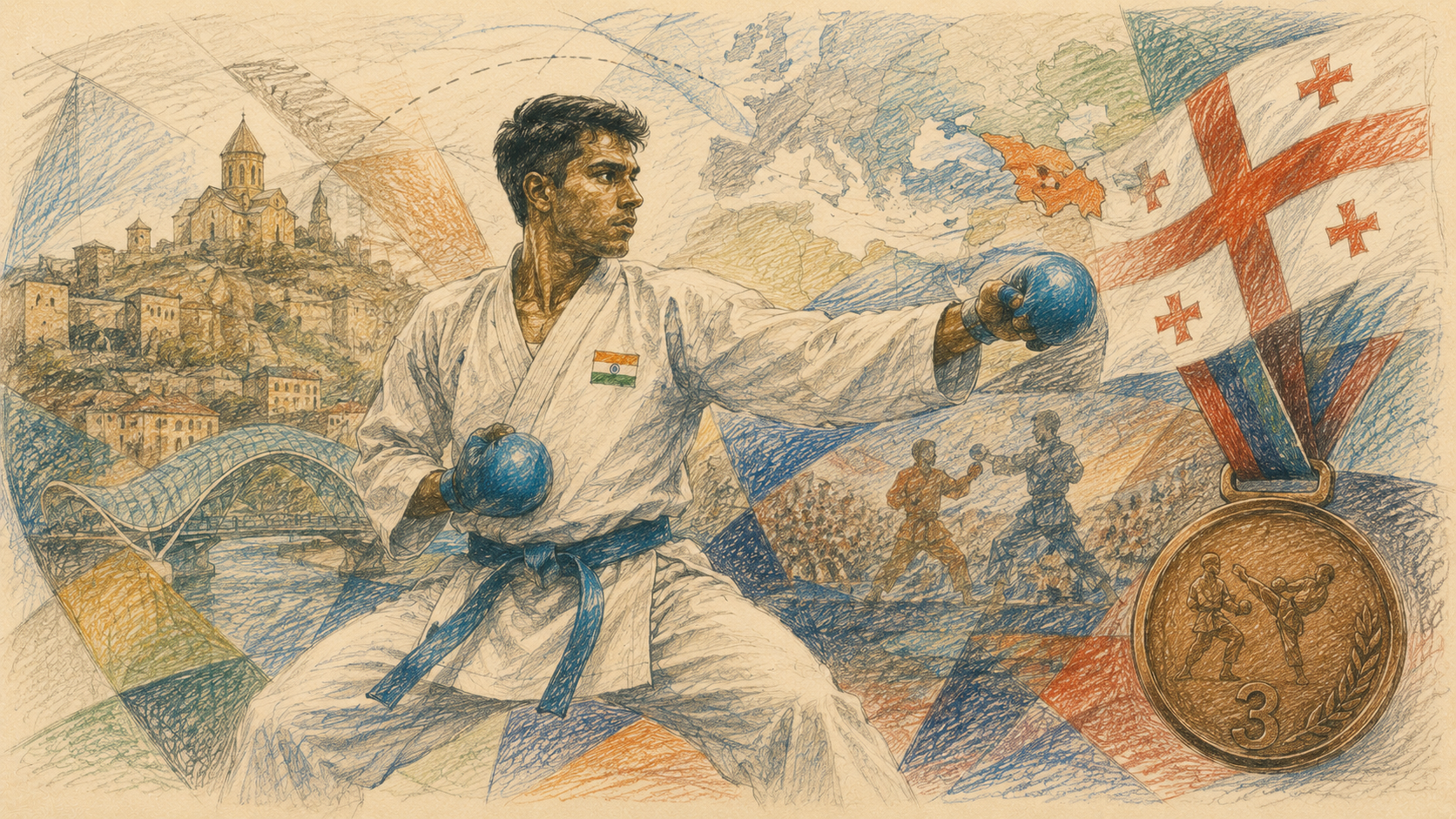
An Indian karate athlete in fighting stance with a bronze medal and scenes of Tbilisi, including a hilltop church and the Georgian flag, in the background
The tatami inside the Olympic Palace in Tbilisi, Georgia, is not a theater of violence. It is an arena of high-speed data transmission. When an athlete launches a Gyaku-zuki (reverse punch) down the centerline during a World Karate Federation (WKF) Series A bout, the objective is not to concuss the opponent. The objective is to transmit a flawless, biomechanical optical signal to a panel of four corner judges and one referee. It is a game of semiotics, played at sixty miles per hour.
For decades, this sterile, highly codified environment has been a geopolitical fortress, entirely impermeable to the Indian martial arts ecosystem. Indian combat sports have historically been anchored in a heavy, grinding, kinetic realism—from the mud pits of Kushti to the flat-footed, force-through-target mechanics of local Kyokushin and Shotokan dojos. But WKF Kumite actively penalizes heavy-handed kinetic damage. It demands the illusion of destruction, arrested precisely one centimeter before impact.
When the Indian contingent secured a landmark bronze medal at the Karate 1 Series A event in Tbilisi this week, it did not represent a sudden increase in the physical toughness of Indian athletes. It represented a massive paradigm shift in institutional intelligence. An Indian fighter finally decoded the Euro-centric judging metrics, the plyometric pacing, and the tactical restraint required to infiltrate the upper echelons of codified global striking. They have hacked the mainframe of the tatami.
The Kinematics of Restraint
To understand the magnitude of this breakthrough, one must deconstruct the physiology of a WKF-sanctioned strike. Traditional combat sports—boxing, Muay Thai, or mixed martial arts—operate on a straightforward kinetic epistemology: damage equals dominance. The athlete accelerates mass through a target, maximizing force transfer ($F=ma$) to induce physiological failure in the opponent.
WKF Kumite operates on an entirely inverted physiological premise. It is governed by the principles of Sun-dome (arresting the technique just before contact) and Zanshin (a state of total spatial and physical awareness following the strike).
Executing a head kick (Jodan Geri) for a three-point Ippon is an act of extreme anatomical contradiction. The athlete must generate maximum explosive velocity through the concentric contraction of the hip flexors and quadriceps, only to instantly trigger a violent eccentric deceleration via the hamstrings and glutes to stop the foot a millimeter from the opponent’s jaw. The metabolic and neurological toll of this deceleration is immense. If the foot makes unprotected contact, the athlete is penalized (a Chui or Hansoku warning for excessive contact). If the retraction (Hiki-te) is slow, the judges will not validate the point, viewing it as a lack of Zanshin.
For generations, Indian karate athletes fundamentally failed at this mechanical puzzle. Conditioned in environments that favored power over precision, their strikes often breached the Sun-dome threshold. They fought with a heavy, grounded stance, rendering them sitting ducks for the fencing-like, plyometric blitzes of their European counterparts. Securing a medal in Tbilisi means that the Indian pipeline has successfully re-engineered its athletes' central nervous systems, replacing a culturally ingrained instinct for heavy impact with the hyper-specialized fast-twitch retraction required by the WKF ruleset.
The Euro-Centric Monoculture of the Point
The rules of WKF Kumite are ostensibly objective, but the enforcement of those rules is inherently geopolitical. A point—whether a single-point Yuko (punch), a two-point Waza-ari (body kick), or a three-point Ippon (head kick or sweep/finish)—is not registered by a sensor. It is registered by human eyes.
Specifically, it is registered by an optical consensus among judges who have historically been conditioned by the European meta. Nations like France, Italy, Azerbaijan, and host-nation Georgia have dominated the WKF circuit for the better part of two decades. They did not just win matches; they dictated the visual aesthetics of a "clean" point.
The European tactical model relies heavily on the "bounce"—a continuous plyometric oscillation that masks the precise moment of kinetic initiation. It utilizes linear, fencing-style lunges that cover massive distances in fractions of a second. More importantly, European fighters mastered the theatrics of the point. They understood that the auditory cue of the kiai (the shout), the dramatic snap of the uniform (the gi), and the immediate return to a dominant, unbothered posture were just as vital as the strike itself. They gamified the subjective biases of the judging panel.
Indian athletes stepping onto the tatami at a Series A event historically found themselves fighting two opponents: the fighter across from them, and an invisible, Euro-centric algorithmic bias. An Indian fighter’s punch could land with identical speed and proximity to an Italian’s, but if it lacked the stylized, culturally approved optical snap that a European judge subconsciously looks for, the flags would remain down.
The bronze medal in Tbilisi is proof that the Indian contingent has stopped complaining about this bias and has instead reverse-engineered it. They have learned to speak the dialect of the WKF judge. They have adopted the plyometric bounce. They have weaponized the Hiki-te. They are no longer bringing a street fight to a fencing match; they are beating the fencers at their own hyper-optimized game.
Overcoming Institutional Attrition
The technical evolution of the Indian athlete is only half the story. The other half is the brutal, attritional war of institutional logistics.
A Karate 1 Series A event is not a glamorous invitational. It is a grueling, meat-grinder of a tournament designed to test the depth and funding of national federations. Brackets in divisions like the Under-67kg or Under-75kg Kumite can feature upwards of 90 to 120 competitors. To reach the podium, an athlete must survive six, seven, or even eight consecutive matches in a single day.
For the state-sponsored athletes of Turkey, Egypt, or Georgia, the Series A circuit is a heavily subsidized operational deployment. They travel with physiotherapists, tactical analysts, and dedicated national coaches who map out opponent tendencies using advanced data tracking.
The Indian karateka, conversely, operates in an environment of high bureaucratic friction. Historically plagued by internal federation disputes, lack of consistent government funding, and the exorbitant costs of self-funding international travel, merely stepping onto the tatami in Tbilisi is an act of logistical defiance.
An athlete enduring a six-match repechage run while dealing with jet lag, lacking a dedicated recovery protocol, and often operating as their own tactical analyst, is fighting at a severe systemic disadvantage. The physiological degradation over the course of a Series A tournament is measurable: by the bronze medal bout, an athlete's fast-twitch muscle fiber recruitment drops significantly, and their central nervous system fatigue drastically reduces reaction times. To win a medal under these structural conditions is an anomaly of sheer grit intersecting with newfound tactical brilliance.
The Vanguard of a New Kinetic Era
The podium in Tbilisi is not the culmination of a journey; it is the breaking of a seal. In the unforgiving geometry of the WKF tatami, success is compounding. A single bronze medal alters the geopolitical gravity of the sport. It forces international judges to recalibrate their subconscious biases. It forces European tactical analysts to start cataloging Indian fighters not as early-round bye-matches, but as legitimate, codified threats.
More importantly, it provides a blueprint for the domestic pipeline. The next generation of Indian martial artists no longer has to guess what works on the global stage. The code has been imported back home. The data points—the exact depth of the plyometric bounce, the precise millisecond of eccentric deceleration, the required decibel level of the kiai—have been validated in the crucible of a Series A event.
India’s integration into the global martial arts elite has been slow, painful, and culturally fraught. But the performance in Georgia proves that the nation is no longer just exporting raw athleticism. It is exporting highly sophisticated, algorithmic combat. The global tatami is no longer a closed European circuit. The perimeter has been breached, and the nature of the game has irreversibly changed.
Part of Issue 2: The Architecture of Belonging, published June 25, 2026→