shooting
The Shared Pulse: The Neurological Symbiosis of Mixed-Team Precision
Abhinav Shaw and Shambhavi Kshirsagar's world-record 505.8 in Suhl required more than individual stillness — it required two teenage nervous systems learning not to panic together.
By Aditya Krishnan, Olympic Sports & Sporting Institutions · June 25, 2026 · 7 min read
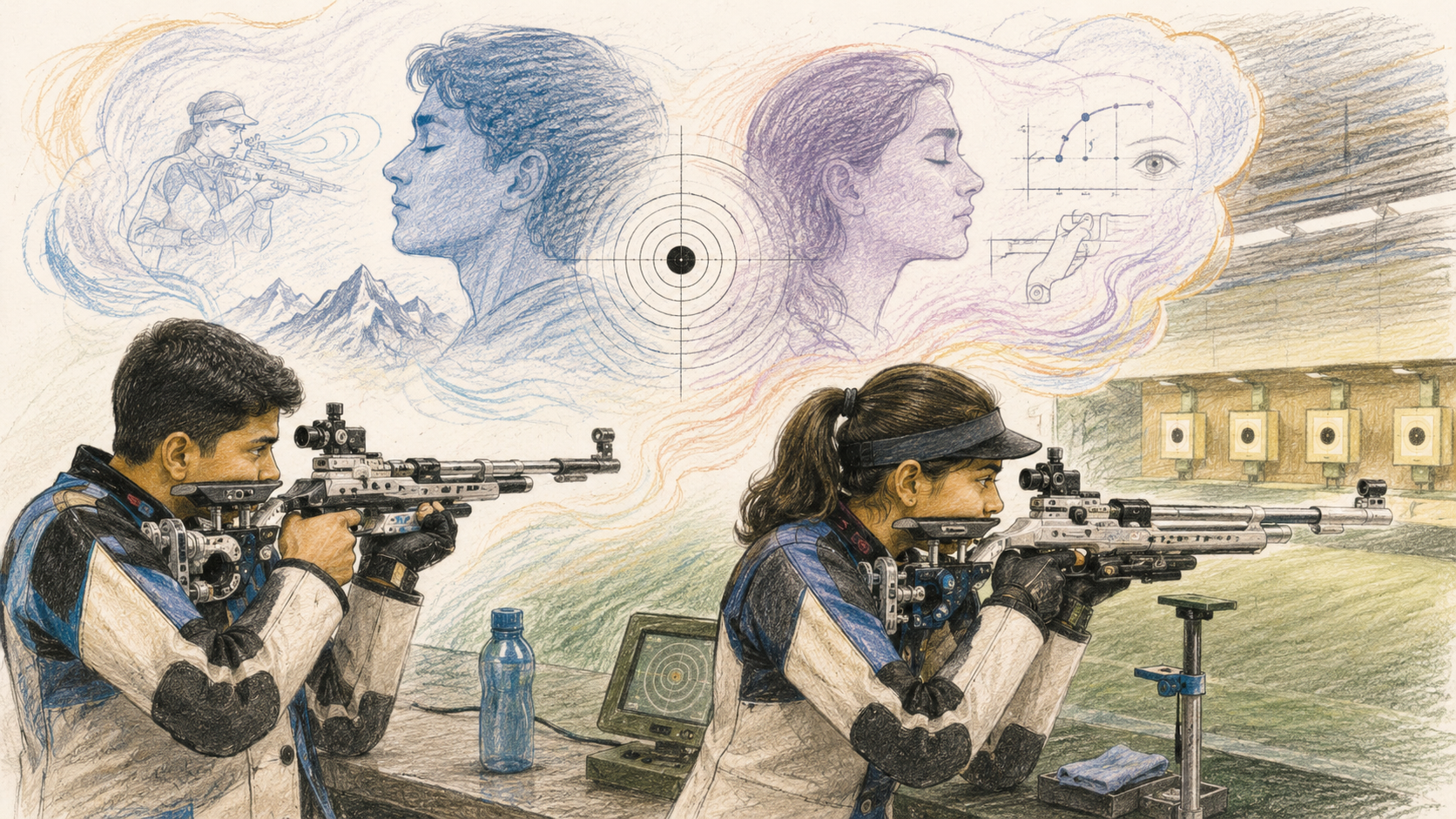
Two young Indian shooters aiming air rifles side by side on a range, with illustrated profile portraits and a target crosshair above them
The Architecture of Silence
Target shooting at the elite level is an anti-sport. It is an athletic endeavor where the ultimate physical goal is not explosive movement, but the absolute eradication of it. In the cavernous, sterile halls of the ISSF Junior World Championship in Germany, there is no roaring crowd to mask the internal cacophony of the athletes. There is only the hum of the ventilation system, the sharp, pneumatic crack of compressed air, and the suffocating weight of expectation.
When Indian junior shooters Abhinav Shaw and Shambhavi Kshirsagar stepped onto the firing line, they were not just battling the geometric constraints of a target stationed ten meters away. They were engaged in a war against their own neurology. To shatter the junior mixed team world record with a combined score of 505.8, they had to achieve a state of physical and mental suspension that defies human evolutionary programming.
The human body is a fundamentally chaotic machine. It vibrates with the pumping of blood, sways with the mechanics of respiration, and twitches through the constant, micro-adjustments of postural muscles engaging in anaerobic glycolysis to maintain a static hold. To shoot flawlessly is to briefly pause mortality—to slow the heart rate, dampen the sympathetic nervous system, and squeeze a trigger in the transient, infinitesimal void between two heartbeats. Doing this alone is a masterclass in limbic regulation. Doing it in a mixed-team format, tethered to the neurological state of a partner, requires an almost telepathic level of physiological symbiosis.
The Micro-Biomechanics of the Solo Void
Before we can understand the symbiosis of the team, we must deconstruct the absolute isolation of the individual shot. A 10.9—the highest possible score on a single shot in 10-meter air rifle—requires striking a central dot that is just 0.5 millimeters in diameter. The projectile itself is 4.5 millimeters. There is no margin for error. A muzzle deviation of a fraction of a millimeter, caused by a sudden spike in pulse or an errant breath, degrades a world-record attempt into a catastrophic failure.
The biomechanical sequence begins with the stance, a rigid kinematic chain designed to transfer the rifle's weight directly into the skeletal structure, minimizing muscular engagement. Muscle introduces tremor; bone offers stillness. As Shaw and Kshirsagar initiate their pre-shot routines, they intentionally trigger a parasympathetic override. Through regulated, diaphragmatic breathing, they increase their vagal tone, forcing their resting heart rates to plummet.
As the eye peers through the diopter sight, visual fixation duration increases. The shooter enters the "hold" phase. Here, the brain commands the index finger to add steady, continuous pressure to a trigger set to break at a weight of mere grams. The timing is a marvel of proprioception and internal rhythm. The release must occur during diastole—the resting phase of the cardiac cycle—because the systolic surge of blood through the arteries of the arm is enough to throw the barrel off the 0.5mm center.
The Contagion of Stress: The Mixed-Team Paradigm
If individual shooting is a solitary confinement of the mind, the mixed-team event introduces a volatile variable: human connection. The 505.8 points amassed by Shaw and Kshirsagar were not shot in a vacuum. They were shot side-by-side, alternating the immense burden of momentum.
Human beings are wired for emotional contagion and physiological mirroring. In high-stress environments, proximity breeds autonomic synchronization. If one partner's sympathetic nervous system spikes—triggering a cortisol dump, shallow breathing, and rapid heart rate—the other partner's limbic system will often unconsciously register and adopt that anxiety. This phenomenon, known as autonomic tethering, is the silent killer of mixed teams. A dropped shot by one partner can induce a microscopic, sympathetic tremor in the other, creating a cascading failure of form.
To succeed, Shaw and Kshirsagar had to engineer a firewall against mutual panic while simultaneously feeding off mutual confidence. When Shaw stepped to the line, Kshirsagar had to manage the agonizing role of the passive observer. The cognitive load of watching your partner—knowing your shared destiny rests on their trigger finger, yet being entirely powerless to affect the outcome—burns massive amounts of psychological energy.
Their ability to string together deep 10s indicates a profound mastery of tactical periodicity. They managed their psychological energy like a finite metabolic resource. When one shooter fired, the other utilized visual disengagement and box-breathing protocols to maintain their own neurological baseline. They did not ride the emotional highs and lows of each other’s shots; they operated as isolated, self-regulating nodes within a shared system, allowing the pressure to dissipate into the floorboards rather than pass between them.
The Juvenile Cortex Under Pressure
The gravity of this 505.8 record is magnified exponentially by the biological reality of the athletes. Shaw and Kshirsagar are juniors. From a neurobiological standpoint, achieving absolute emotional homeostasis during adolescence is a developmental paradox.
In the adolescent brain, the amygdala—the region responsible for processing immediate emotional responses and fear—is fully active and hyper-reactive. Meanwhile, the prefrontal cortex, which governs executive function, emotional regulation, and long-term consequence evaluation, is still undergoing myelination. The biological hardware of a teenager is literally optimized for impulsivity and emotional amplification, not for the cold, calculating suppression required to shoot a 10.8 under the lights of a World Championship final.
Yet, observing their cadence, one saw the architecture of veteran minds. They demonstrated an elite capacity for "error-negation." In shooting, a 9.9 is heavily penalized not just on the scoreboard, but in the psyche. The physiological shock of a bad shot can linger, causing the next shot to be rushed or over-aimed. Shaw and Kshirsagar displayed a remarkable ability to sever the neurological link between past failure and future performance. Their interbeat intervals (IBI) between shots remained terrifyingly consistent. They effectively rewired their juvenile fight-or-flight responses into a state of hyper-focused flow.
The Geography of 505.8: A Statistical Anomaly
To truly grasp the magnitude of the 505.8 record, one must strip away the romance of the narrative and look at the brutal, unyielding mathematics of the target.
In modern decimal scoring, the 10-ring is divided into tenths, radiating outward from the absolute center. A 10.0 barely grazes the outer edge of the dot. A 10.9 requires obliterating the exact center. Across their record-breaking series, Shaw and Kshirsagar maintained an average so high that their combined spatial deviation from absolute center across all shots could likely be measured in the width of a few human hairs.
This is a demonstration of Elo-equivalent dominance that defies traditional athletic metrics. In sports like basketball or tennis, elite performance is fluid; a player can adjust a flawed swing mid-motion, or recover on defense. In shooting, once the sear disengages from the trigger, physics takes absolute control. There is no recovery. The pellet travels down the barrel in roughly two milliseconds, subjected to the micro-vibrations of the barrel harmonics. Every 10.5 or higher they shot meant they successfully aligned their skeletal geometry, managed their breathing, suppressed their heart rate, ignored the ambient pressure, and executed a perfect neuro-muscular trigger break.
And they did it repeatedly, relentlessly, until the math simply broke in their favor.
The Resonant Truth
When the final pellet struck the electronic target and the 505.8 was formalized, the true achievement was not merely mathematical. What Abhinav Shaw and Shambhavi Kshirsagar accomplished in Germany was a profound exhibition of biological mastery and mutual trust.
They survived an environment designed to unravel the mind. They took the innate human vulnerability of the mixed-team format—the dangerous, contagious nature of shared anxiety—and inverted it. They used the presence of a partner not as a conduit for stress, but as an anchor for stability. In a sport where victory demands total physical silence, two adolescent athletes managed to sync their physiological noise, lowering their heart rates in tandem, finding the same diastolic voids, and proving that sometimes, the most impenetrable armor an athlete can wear is the quiet, unspoken rhythm of the person standing beside them.
More From The Field Weekly
Part of Issue 2: The Architecture of Belonging, published June 25, 2026→