chess
The Deconstruction of "Clutch" in the Silicon Age
How a 20-year-old grandmaster's triumph in Oslo exposes the psychological rewiring of chess by a generation raised on neural networks.
By Vikram Rao, Chess & Strategy · June 18, 2026 · 6 min read
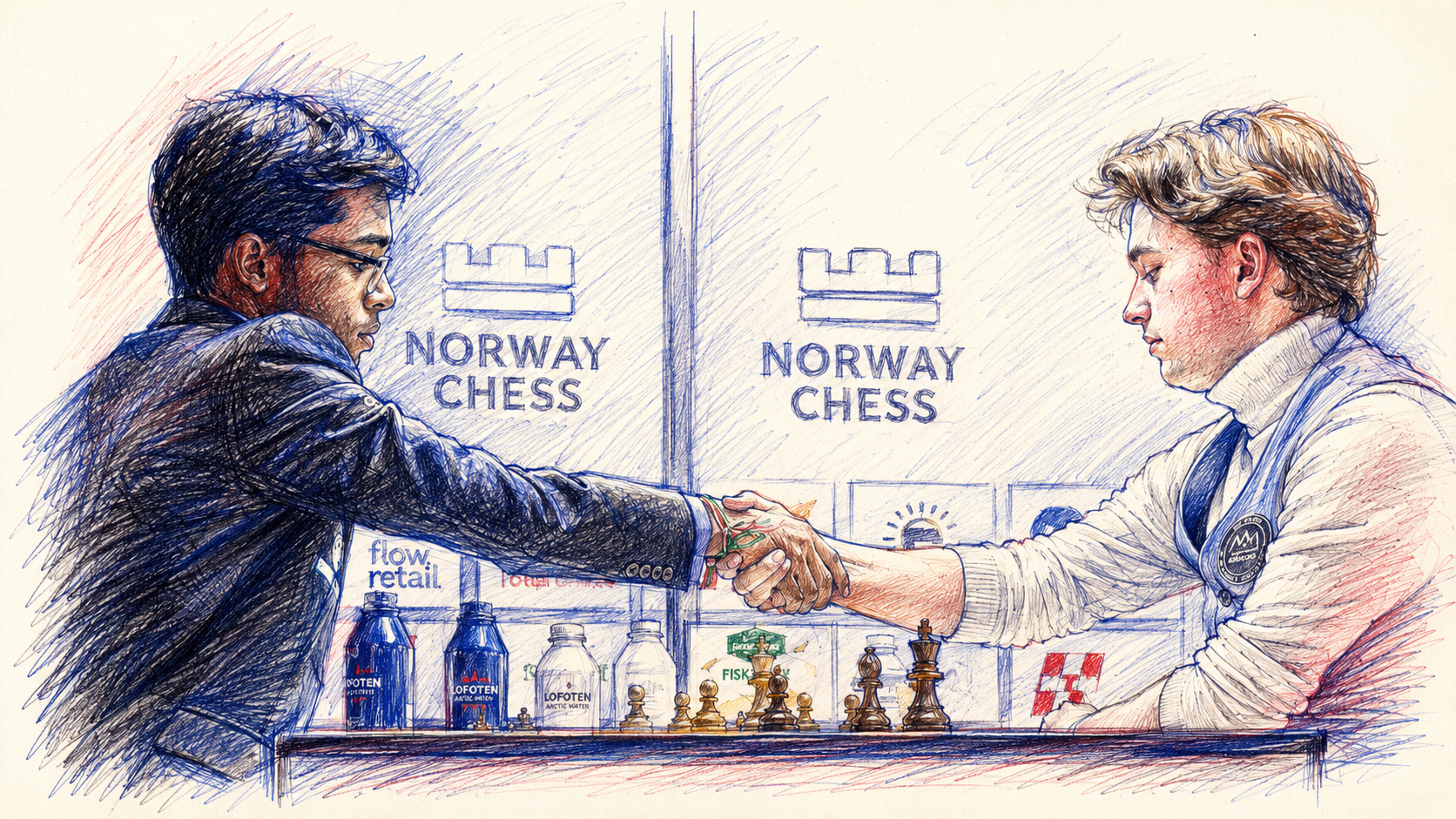
Illustration of Rameshbabu Praggnanandhaa shaking hands with an opponent across the board at the Norway Chess tournament
OSLO — There is a specific kind of silence that descends upon a chess hall when a king is irreparably cornered. It is not the sudden hush of a missed free throw or a dropped pass in a packed stadium; it is a creeping, suffocating quiet that fills the room as options evaporate from the board. In the final round of the 2026 Norway Chess tournament, that silence belonged entirely to the brilliant German grandmaster Vincent Keymer. Across the board sat 20-year-old Rameshbabu Praggnanandhaa, whose eyes, wide and unblinking, barely registered the tectonic magnitude of what he was about to achieve.
With a brutal, mathematically clean kingside assault, Praggnanandhaa dismantled Keymer’s defenses in a classical game that will be studied for decades. The victory completed an astonishing four-game classical winning streak, securing him the title at one of the world's most unforgiving super-tournaments. He became the first Indian to ever win the event.
When Keymer extended his hand in resignation, Praggnanandhaa did not pump his fist. He did not exhale a heavy rush of human relief, nor did he look up to scan the room for validation. He simply stopped the clock, neatly signed his scoresheet, and walked away from the board.
To understand the sheer improbability of this triumph—a run that saw him defeat reigning World Champion D Gukesh, the hyper-creative Alireza Firouzja, and, most remarkably, World No. 1 Magnus Carlsen twice in classical games—one must look past the standard sportswriting tropes of grit and determination. Praggnanandhaa’s victory represents something far more profound: a complete, structural deconstruction of how competitive composure, or "clutch," functions in the modern era.
The Death of the Human Heuristic
For over a century, the final rounds of elite chess tournaments were romanticized as crucibles of human frailty. The classical paradigm, championed by the twentieth-century Soviet school of chess, viewed the game as a psychological duel wrapped in a sporting frame. Players were expected to buckle under the weight of history, time trouble, and positional tension. In that old world, the "clutch" player was an apex predator of nerves—someone who could suppress their own anxiety just long enough to exploit the visible terror of the person sitting across from them. Training involved studying dogmatic heuristics: rigid rules about pawn structures, the absolute value of the bishop pair, and safe King safety zones.
The young vanguard from India represents a clean break from this lineage. Praggnanandhaa belongs to the first generation of grandmasters whose formative intellectual development occurred in complete synthesis with neural-network engines like Leela Chess Zero and ultra-advanced iterations of Stockfish. These engines do not think in human heuristics. They do not care about the historical sanctity of a pawn structure, nor do they experience a spike in cortisol when a king is left exposed in the center of the board if the concrete tactics justify it.
When an adolescent spends thousands of hours sparring against an intelligence that calculates billions of nodes per second without an emotional pulse, their internal cognitive architecture is irrevocably altered. This has birthed the era of synthetic intuition.
Praggnanandhaa does not rely on emotional momentum or the traditional psychological safety nets of classical theory. He approaches a high-stakes final round not as a dramatic narrative to be survived, but as an isolated, non-linear mathematical puzzle where human stress is merely noise to be filtered out.
Mechanizing the Inevitable
Nowhere was this detached stoicism more apparent than in his twin classical victories over Magnus Carlsen. For nearly fifteen years, Carlsen has dominated the sport not merely through superior calculating depth, but by cultivating an aura of absolute positional inevitability. Carlsen’s signature methodology is psychological suffocation: he deliberately steers games away from sharp, theoretical lines into deeply complex, marginally superior endgames. He then waits, often for five or six hours, for the human brain's natural error rate to scale upward under fatigue. He plays the player, not just the board.
In Oslo, Praggnanandhaa simply refused to participate in the theater. Facing the greatest endgame player in history on his home turf, the young Indian grandmaster did not play with the cautious reverence that has doomed dozens of Carlsen’s opponents. Instead, he treated Carlsen’s legendary pressure as an invariant system.
When Carlsen attempted to complicate the transition from the middlegame into an asymmetric ending, Praggnanandhaa responded with a series of engine-honed, counter-intuitive moves that stripped the position of its emotional ambiguity. He found tactical fissures that defied classical intuition but were provably flawless under cold calculation. He executed the winning sequences with the mechanical indifference of an automated system.
Even Carlsen, a competitor notoriously sparing with his praise and deeply protective of his home domain, was forced to acknowledge the shift. "He won the last four classical games. That's as clutch as it gets," Carlsen remarked following the closing ceremony. "That's pretty insane... Pragg is an incredible fighter, and it's fun to see him get rewarded for that."
The Autonomy of the Independent Trial
The true test of this modern cognitive rewiring, however, occurred earlier in the tournament. Following a difficult start that left him languishing in the middle of the pack and trailing a red-hot Wesley So, Praggnanandhaa appeared to be structurally out of contention. In the traditional framework of chess psychology, a bad start creates a cumulative deficit; the player experiences "tilt," a behavioral bias where past losses compromise future risk assessment.
But the hallmark of the silicon-trained mind is the complete compartmentalization of data. To a neural network, Game 6 has no awareness of Game 5. Each round is an independent statistical trial.
When the tournament reached its critical final weekend, Praggnanandhaa did not press or play with the frantic desperation of someone chasing a miracle. He simply continued to generate highly accurate, unromantic, and deeply testing lines. His four-game winning streak was not an emotional surge; it was the statistical yield of maintaining a near-flawless level of accuracy while his opponents, operating under the old laws of human stress, began to fracture.
As fans and international media mobbed him on the streets of Oslo—a scene far more reminiscent of a young pop icon than a traditionally insular chess grandmaster from Chennai—Praggnanandhaa finally allowed himself a brief, authentic smile. It was a rare flash of the twenty-year-old behind the grandmaster facade.
Yet, beneath the warmth of that celebration lies a chilling realization for the old guard of international sport. The chessboard is no longer an auditorium for classical human drama, nor is "clutch" an act of emotional heroism. It has become a silicon forge—and Praggnanandhaa has shown that the youngest generation is perfectly comfortable operating the hammer.
More From The Field Weekly
Part of Issue 1: The Long Game, published June 18, 2026→