chess
The Illusion of the Cohort
Arjun Erigaisi's solitary place in chess's global Top 10 dismantles the comforting myth of India's "Golden Generation" — and reveals how differently elite players choose to take on risk.
By Vikram Rao, Chess & Strategy · June 18, 2026 · 5 min read
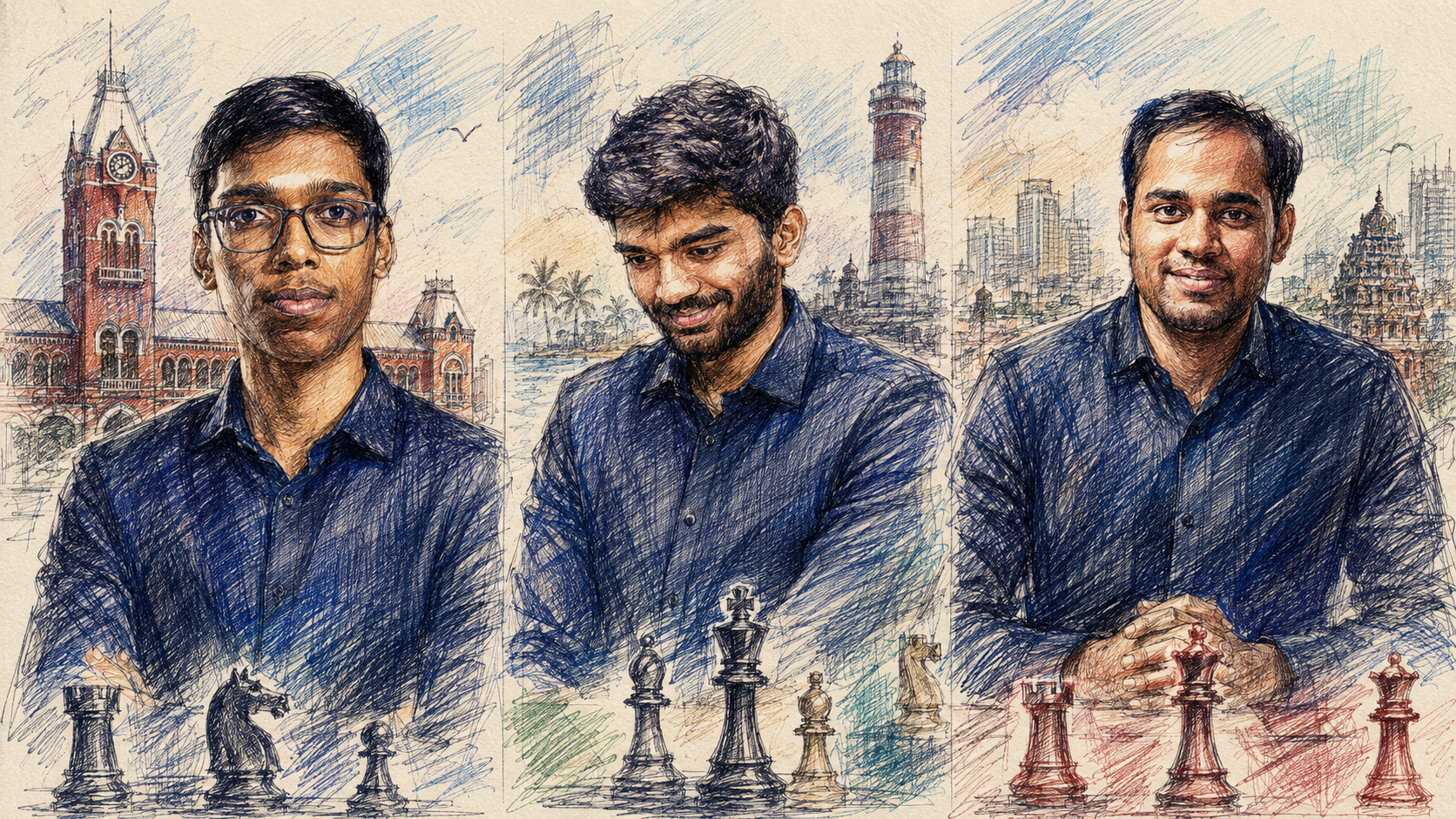
Illustrated triptych portraits of Indian grandmasters R Praggnanandhaa, D Gukesh, and Arjun Erigaisi with chess pieces and city skylines behind them
LAUSANNE — The FIDE rating list is a brutally unsentimental document. Published monthly by the International Chess Federation, it does not care about national narratives, patriotic momentum, or the romantic storylines peddled by sports broadcasters. It simply runs the Elo algorithm and ranks human intellect in cold, unyielding numerals.
When the June 2026 rating list was published, the Indian media instinctively scoured the Top 10 for the familiar cluster of prodigies. For the last three years, the sporting press has aggressively packaged R Praggnanandhaa, D Gukesh, and Arjun Erigaisi into a single, monolithic entity. They are sold to the public as the "Golden Generation" or the "Chennai Cohort"—a band of brothers marching arm-in-arm to dismantle the Russian and Western hegemony of elite chess.
But a glance at the Top 10 revealed a glaring disruption to that narrative. There was no cluster. There was no cohort. There was only one Indian flag planted inside the absolute highest echelon of the sport, and it belonged solely to 22-year-old Arjun Erigaisi.
Erigaisi’s solitary stand at the summit is not an anomaly; it is a necessary awakening. It exposes the fatal flaw in how we consume modern chess. By bunching these distinct minds into a singular "Golden Generation," we strip them of their profound individuality. We forget the most terrifying truth of the game: at the absolute summit of chess, there are no teams. There is only a wooden board, a ticking clock, and the suffocating loneliness of your own decisions.
The Myth of the Collective
It is entirely understandable why the media desperately wants the cohort to exist. A "Golden Generation" provides a tidy, easily digestible storyline. It implies a shared secret, a collective laboratory where these young men sit around analyzing opening novelties and sharing their psychological triumphs. It evokes the image of a relay race, where one player passes the baton to the next.
But chess is not a relay race, and it is certainly not a team sport.
When you are sitting in a silent hall, staring at a board with thirty seconds left on your clock, your heart rate spiking to 150 beats per minute, it does not matter that you and the man at the next table grew up in the same country. You cannot borrow his intuition. You cannot ask him to calculate the geometry of a knight fork. You are marooned on an intellectual island.
The path to the Top 10 is not a wide, paved road where players can walk side-by-side. It is a razor-thin tightrope. And the moment we look closely at how Erigaisi climbed onto that tightrope, the illusion of the cohort instantly shatters.
The Architecture of Chaos
To understand why Erigaisi stands alone in the Top 10 right now, you have to understand his deeply personal, almost reckless philosophy on risk.
If we must use analogies, think of it this way: D Gukesh plays chess like a master architect. He builds mathematically sound, structurally flawless fortresses, prioritizing classical principles and ironclad defense. Praggnanandhaa plays like a Silicon Valley engineer, perfectly blending human psychology with the synthetic intuition of a supercomputer to find clutch solutions under pressure.
Arjun Erigaisi plays like a street fighter who happens to be wearing a tuxedo.
While his peers have largely transitioned into the protective bubble of elite, closed "super-tournaments" (where the top players play each other, draw frequently, and protect their ratings), Erigaisi chose a path of chaotic violence. Over the last two years, he actively chose to play in massive, grueling "Open" tournaments.
In the chess world, an elite 2750+ rated player entering an Open is the equivalent of a billionaire walking into a casino and putting his entire net worth on the roulette table. Because Erigaisi's rating is so much higher than the field, the Elo algorithm punishes him severely. If he draws a game against a 2600-rated player, he bleeds rating points. To gain points, he cannot just play well; he is mathematically forced to win almost every single game he plays.
Wading Into the Deep End
To survive that kind of pressure, Erigaisi had to deliberately unlearn the safe, drawing variations that modern super-grandmasters rely on. He began playing "sub-optimal" moves on purpose—moves that a computer might scoff at, but which drag his human opponents into dark, confusing, and terrifyingly complicated positions. He creates messes on the board because he knows he can navigate the chaos better than the man sitting across from him.
This is not a strategy you learn in a cohort. This is a deeply personal, psychological choice. It requires an appetite for risk that borders on the masochistic. Erigaisi reached the Top 10 not because he was pulled up by the rising tide of Indian chess, but because he was willing to swim in much more dangerous waters than anyone else.
The Solitary Summit
The media's desire to group these young men together is born of national pride, and there is nothing inherently wrong with celebrating the geographic anomaly of so much talent emerging from one nation. But true appreciation of their genius requires us to separate them.
When Arjun Erigaisi sits at the board, he is not carrying the "Golden Generation" with him. He is executing a highly disparate training methodology, fueled by a unique nervous system, and guided by a personal philosophy on risk that his peers do not share.
The June FIDE rankings update is a cold reminder of the ultimate reality of elite chess. The summit of the sport only fits one chair at a time. The illusion of the cohort is a comforting story for the spectators, but for the players, that illusion completely dissolves the moment the arbiter starts the clock.
More From The Field Weekly
Part of Issue 1: The Long Game, published June 18, 2026→