chess
The Fragility of the Engine Hive: Why Collective Rating Superiority Crumbles Under Time Panic
India’s 1–3 stumble against hosts Uzbekistan in Round 6 of the Samarkand Olympiad revealed the hidden liability of a generation raised on 0.00 evaluations — what happens when the tactical board becomes an emotional trap.
By Vikram Rao, Chess · September 24, 2026 · 6 min read
Grandmasters calculating over a chessboard during the 46th FIDE Chess Olympiad in Samarkand
SAMARKAND — Inside the cavernous Silk Road International Exhibition Centre, chess looks less like an ancient board game and more like a high-density computational server farm. Two hundred teams, four hundred boards, and eight hundred clocks ticking down in asynchronous silence. For five rounds, the Indian Open team moved through this room with the calm, terrifying efficiency of an industrial automation plant.
They had crushed their early opponents without conceding a single board loss. In Round 5, they dismantled the formidable Netherlands 3–1, with R. Praggnanandhaa suffocating Anish Giri in a Catalan squeeze and D. Gukesh outlasting Erwin l'Ami in a complex rook ending. On paper, India was not just the top seed; they were the statistical monolith of modern chess—a collective average rating touching 2765, boasting World Championship contenders on boards one and two, supported by a bench capable of anchoring almost any other national squad on earth.
Then came Round 6 against hosts Uzbekistan. And in the space of ninety minutes, the computational monolith splintered.
India did not merely lose 1–3 to the defending champions; they lost in a manner that felt deeply ideological. The centerpiece was GM Nihal Sarin’s horrifying queen blunder against GM Nodirbek Yakubboev on board three—an unforced tactical hallucination occurring from an objectively winning endgame position under the brutal strobe of increment time.
The post-mortem across social media immediately defaulted to the standard tropes: nerves, bad form, the hostile roar of the local Uzbek crowd.
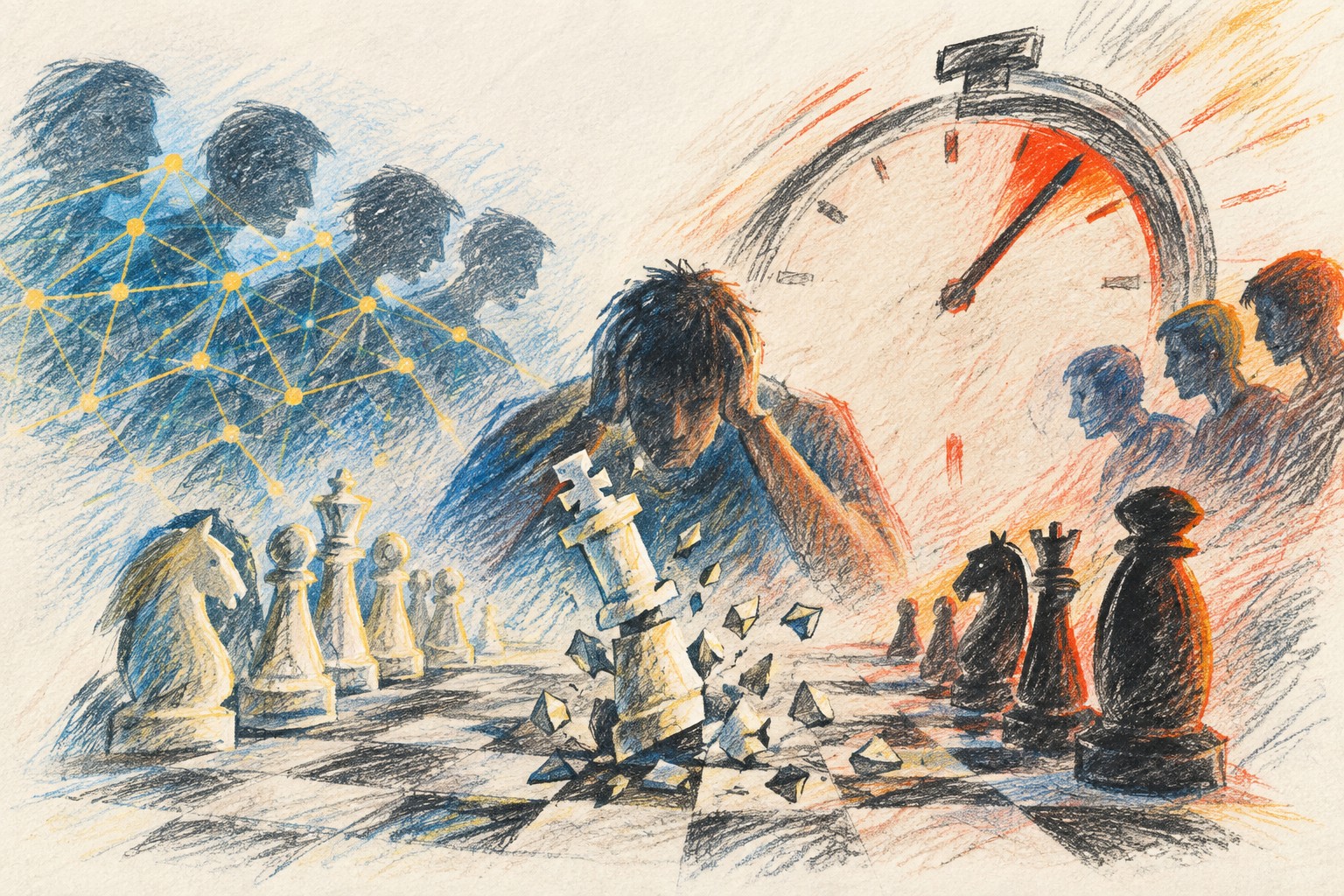
None of these explanations touch the real rot. What happened in Samarkand was not a failure of individual chess calculation. It was an acute systemic failure of the "Engine Hive"—the cognitive vulnerability peculiar to a generation of grandmasters who have outsourced their aesthetic intuition to neural network evaluations.
The Illusions of +0.40
To understand the modern Indian grandmaster, one must understand how they converse with their computers.
Players like Gukesh, Praggnanandhaa, and Nihal Sarin came of age in an era dominated by Leela Chess Zero and Stockfish 16. In their daily training regimens, every position is stripped of ambiguity. An evaluation bar hovers beside every line: +0.42, +0.18, 0.00.
This immersion produces unprecedented precision. Young Indian players navigate forty moves of dense Sicilian or Ruy Lopez opening theory with zero error margin. They know the exact square where a knight must pivot on move 23 to maintain a microscopic positional edge.
However, this reliance conceals a profound cognitive asymmetry: an engine does not experience adrenaline.
An engine evaluates a +0.40 advantage knowing that if it plays thirty consecutive "best" moves—often counterintuitive, cold-blooded king shuffles or retreating pawn sacrifices—it will slowly choke the opponent. But over the board, under the suffocating pressure of an Olympiad hall with two minutes on the clock, human biology intervenes.
Against Uzbekistan, the Indian team repeatedly chose lines that were "objectively" +0.35 according to their preparation, but humanly agonizing to defend. They sought microscopic control in positions that demanded broad, slashing violence. They played like engineers attempting to calibrate an optical lens while their workshop was on fire.
The Uzbek Guerrilla Doctrine
The young Uzbek squad—led by Nodirbek Abdusattorov, Javokhir Sindarov, and Nodirbek Yakubboev—has developed what can only be termed an anti-engine guerrilla doctrine.
They do not try to out-prepare India in the quiet corridors of the Queen’s Gambit Declined. Instead, they seek positions of maximum tactical friction and psychological discomfort. They are willing to accept an evaluation of -0.20 or -0.40 if it introduces structural imbalance, cuts off easy piece coordination, and forces the game into a chaotic hand-to-hand knife fight in time trouble.
This was vividly demonstrated on board three. Nihal Sarin, famous for his superhuman speed in online blitz, achieved a strategically dominant position against Yakubboev. By move 35, the Indian held an extra pawn, active rooks, and a passed pawn rolling forward. The computer evaluation flashed +2.8—a technical win.
Yet Yakubboev did not resign. He began playing spite moves: strange, nagging knight checks, creating bizarre geometrical traps, burning down Nihal’s clock.
Here, the cognitive breakdown occurred. In an engine world, a winning position is a smooth descent to a tablebase win. In human Olympiad match play, a winning position requires emotional closure. As Nihal’s clock dipped below thirty seconds, he was no longer searching for good human moves; he was searching for the definitive, perfect move that his engine training assured him must exist.
Under the pressure of that perfectionism, the mind short-circuits. Nihal moved his queen onto an undefended square, walked into a discovered tactic, and resigned two moves later with his head buried in his trembling hands.
The Solitary Burden of Board Match Play
There is another, deeper dimension to the Samarkand defeat: the unique agony of the 4-board Olympiad format.
In an individual super-tournament like Wijk aan Zee or the Candidates, an elite player manages only their own risk. If Gukesh or Praggnanandhaa feels unsure of a complicated tactical sacrifice, they can choose to steer the game toward a solid, lifeless draw and live to fight another day.
In an Olympiad, you are playing four simultaneous games tethered by an invisible umbilical cord.
When Gukesh glanced sideways and saw board four under pressure, his internal risk calculation changed. When Praggnanandhaa on board one realized that a draw would not suffice to save the match, he was forced to overextend in an equal endgame. The collective weight of four boards creates a feedback loop of anxiety.
India's team is a collection of brilliant individual prodigies, but they are solitary monks of the game. Uzbekistan operates like a street gang. Their players feed on the noise, the flag-waving, the chaos of collective momentum. They play Olympiad chess not as four parallel mathematical proofs, but as a collective physical brawl.
The Path Forward
The Samarkand Olympiad is far from over. With five rounds remaining and a rest day to regroup, India has the sheer depth to mount a comeback and reclaim the gold medal. The women’s team showed the blueprint by rebounding instantly from their loss against Poland to sweep the United States 3–1, anchored by the cold-blooded pragmatism of Savitha Shri and Vantika Agrawal.
For the men’s squad, the lesson of Round 6 must be learned quickly: the computer is a fantastic tutor, but it is a terrible general.
To win a tournament as brutal and unforgiving as the Chess Olympiad, you cannot simply calculate the truth of the board. You must calculate the psychological fracture point of the man sitting opposite you. Until India learns to embrace the dirt, the clock-scrambles, and the imperfect, messy human art of the swindle, their statistical dominance will remain fragile against teams that know how to make them bleed.
More From The Field Weekly
Part of Issue 3: The Friction of Ascent, published September 24, 2026→