combat-sports
The Unsanctioned Podium: How Indian MMA Fought Past Bureaucracy to Claim Its Tatami
Suchika Tariyal’s historic Asian Games bronze in Nagoya was achieved without federation largesse, state academies, or corporate sponsorship — proving again that India’s best fighters emerge outside the system, not because of it.
By Meera Chandrasekaran, Wrestling & Combat Sports · September 24, 2026 · 5 min read
Indian MMA fighter Suchika Tariyal in the cage raising her fist in victory at the Asian Games
NAGOYA — The official Indian contingent handbook for the 20th Asian Games is a dense, bureaucratic document of prestige. It details the pedigrees of shooters funded by the Target Olympic Podium Scheme (TOPS), track and field athletes with bespoke foreign training stints in Spala and St. Moritz, and badminton players backed by multi-million-rupee corporate sports foundations.
On page 142, buried beneath the equestrian entries, sat the name of Suchika Tariyal. There was no foreign coach listed. There was no corporate sponsor logo beside her biography. Her primary training facility was listed not as a Sports Authority of India (SAI) High-Performance Center, but a cramped, basement combat gym in South Delhi whose roof leaks during the monsoon.
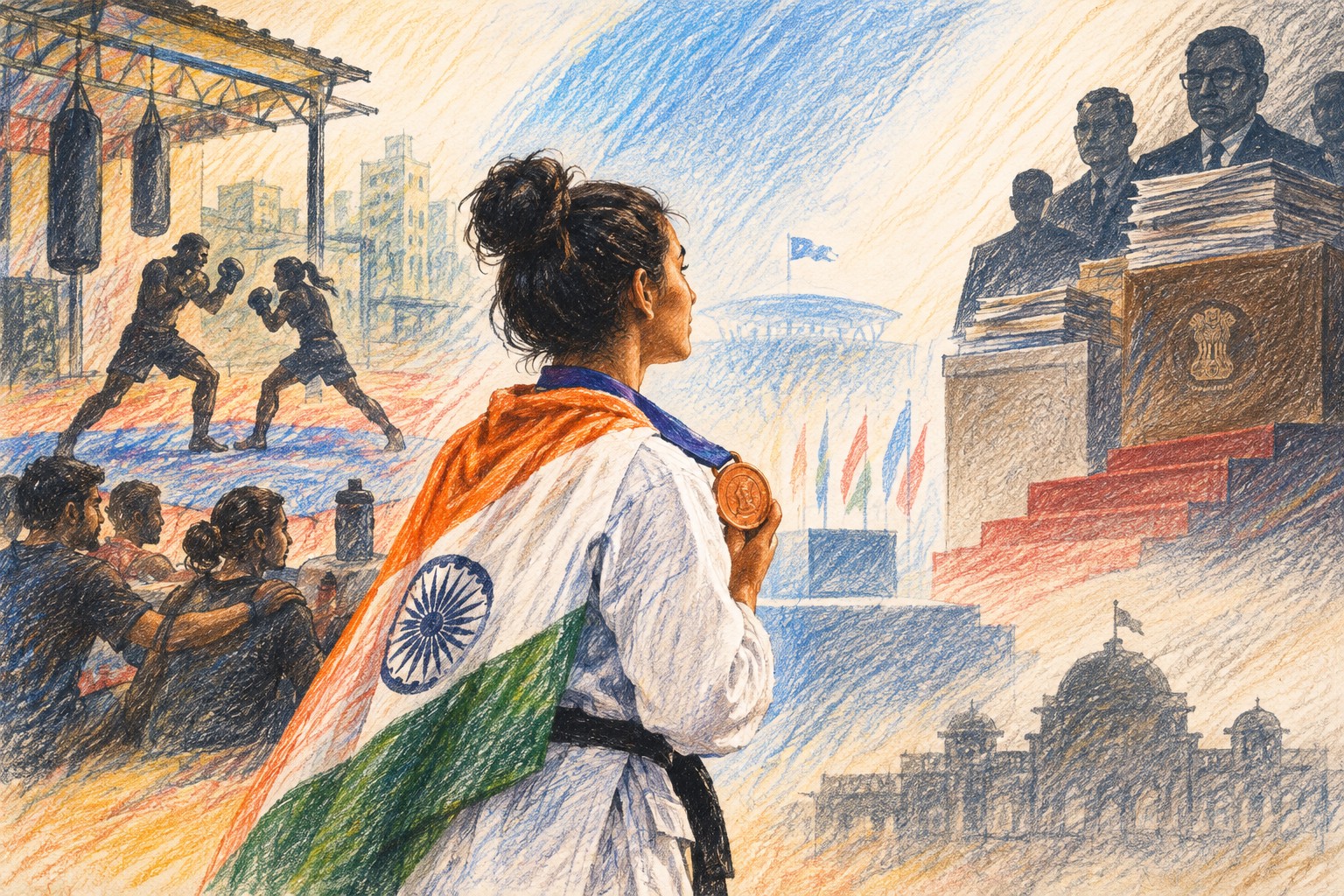
On Sunday morning in Nagoya, Tariyal stepped onto the canvas of the Aichi Prefectural Gymnasium and won a bronze medal in the women’s traditional -60kg mixed martial arts division.
It was India’s first-ever Asian Games medal in MMA. In the press boxes and ministry WhatsApp groups in New Delhi, the medal was instantly claimed as another triumph for the nation's rising sporting prowess.
The celebration is an act of breathtaking institutional hypocrisy.
Suchika Tariyal’s medal was not won with the help of Indian sports governance. It was won in open defiance of it.
The Caste System of Indian Combat
To understand why Tariyal’s podium finish is an anomaly, one must grasp the rigid, feudal hierarchy that governs combat sports in India.
At the summit sits Olympic freestyle wrestling, protected by the historical weight of the northern akhadas and the electoral leverage of Haryana’s rural belt. Beside it sits amateur boxing, shielded by its military and paramilitary recruitment quotas. These sports, despite their frequent leadership crises, enjoy structural legitimacy: government jobs, railway postings, and state cash rewards.
Below them lies the abyss of non-traditional martial arts.
For decades, the Ministry of Youth Affairs and Sports and the Indian Olympic Association (IOA) have treated Mixed Martial Arts not as an athletic pursuit, but as an uncouth commercial novelty—a bastardized hybrid unfit for sovereign support. When the Olympic Council of Asia (OCA) announced that traditional MMA formats would feature as a medal event in Aichi-Nagoya, the response from Shastri Bhavan was cold indifference.
There was no national trial organized by a recognized national sports federation, because no recognized federation existed. Instead, three rival private associations spent two years dragging one another to the Delhi High Court over who owned the rights to select the squad.
Tariyal had to crowdfund her own medical clearances, pay for her own international anti-doping certifications, and purchase her own competition uniforms. Two weeks before the team was scheduled to fly to Nagoya, the Indian Olympic Association threatened to withhold accreditation because the MMA squad lacked an "acceptable administrative lineage."
She traveled to Japan on an economy ticket paid for by personal debt, accompanied by a coach who had to purchase a general spectator ticket to enter the arena.
The Evolution of the Indian Striker
What makes Tariyal’s bronze so technically compelling is that it exposes the tactical evolution occurring at the fringes of Indian fighting.
Historically, when Indian athletes crossed over from wrestling into mixed disciplines, their fight profiles were painfully one-dimensional. They relied exclusively on the aggressive, bull-rushing double-leg takedowns taught in the mud pits of Rohtak or Kolhapur. When confronted with sophisticated guard players who could threaten with guillotine chokes from their backs, or European strikers who controlled distance with crisp, linear jabs, Indian wrestlers routinely ran into tactical ambushes.
Tariyal’s performance in Nagoya demonstrated an entirely new, modern fighting identity.
A former judoka who transitioned to Brazilian Jiu-Jitsu and Muay Thai, Tariyal does not rely on brute, upper-body tie-ups. In her quarterfinal bout against a formidable Kazakh opponent, Tariyal controlled the center of the cage with disciplined leg kicks, systematically chewing up the lead calf to immobilize her opponent’s forward movement.
When the fight went to the canvas, she showed none of the frantic, upright posture that often plagues traditional Indian grapplers unfamiliar with submission defense. She operated with calm, compact hip pressure, passing the guard with patient shoulder-pressure distribution before locking in a decisive keylock submission in the third round.
This is not akhada wrestling. It is the sophisticated, hybridized striking and grappling language of global mixed martial arts. And it is being taught not in state academies, but by a decentralized collective of independent coaches operating out of commercial martial arts academies in Dehradun, Bengaluru, Imphal, and Delhi.
The Commercial Reality
The institutional disdain for MMA in India is rooted in an aging bureaucratic mindset that believes sport only exists if it is funded and controlled by an IAS officer sitting atop a federation board.
Yet, while traditional federations spend their time issuing show-cause notices and filing contempt petitions, the domestic commercial combat market is exploding. Millions of young Indians in tier-two and tier-three cities are not watching domestic Greco-Roman wrestling championships; they are watching ONE Championship, the UFC, and regional fight circuits on their smartphones.
Young fighters like Tariyal are products of this democratization. They do not wait for a district sports officer to sign their travel allowances. They monetize their skills through personal training, regional fight purses, and combat seminars. They treat their bodies not as wards of the state, but as autonomous professional athletic enterprises.
The Reckoning
When Suchika Tariyal stepped onto the podium in Nagoya to collect her bronze medal, she did so with a shiner beneath her left eye and the Indian flag draped over her shoulders. The officials from the Indian delegation who had spent the preceding six months questioning her eligibility were suddenly jostling to be in the frame for the medal photograph.
The victory in Nagoya should not be remembered as an administrative success. It must be remembered as an indictment.
It proved that the geography of Indian combat talent has outgrown the narrow boundaries drawn by the ministry. If India wants to become a genuine global sporting power, it must stop treating sports outside the 19th-century Olympic curriculum as second-class pursuits.
Suchika Tariyal won her medal with blood, sweat, and credit card interest. The medal belongs to her and her basement gym. The system simply had the privilege of watching it happen.
More From The Field Weekly
Part of Issue 3: The Friction of Ascent, published September 24, 2026→