football
Forced Genesis: The Artificial Incubation of the Domestic Attacker
The AIFF's mandate that every ISL club field an Indian striker for all 90 minutes is a deliberate, controversial bet that protectionism can manufacture the instinct the transfer market never will.
By Ananya Pillai, Football · June 25, 2026 · 6 min read
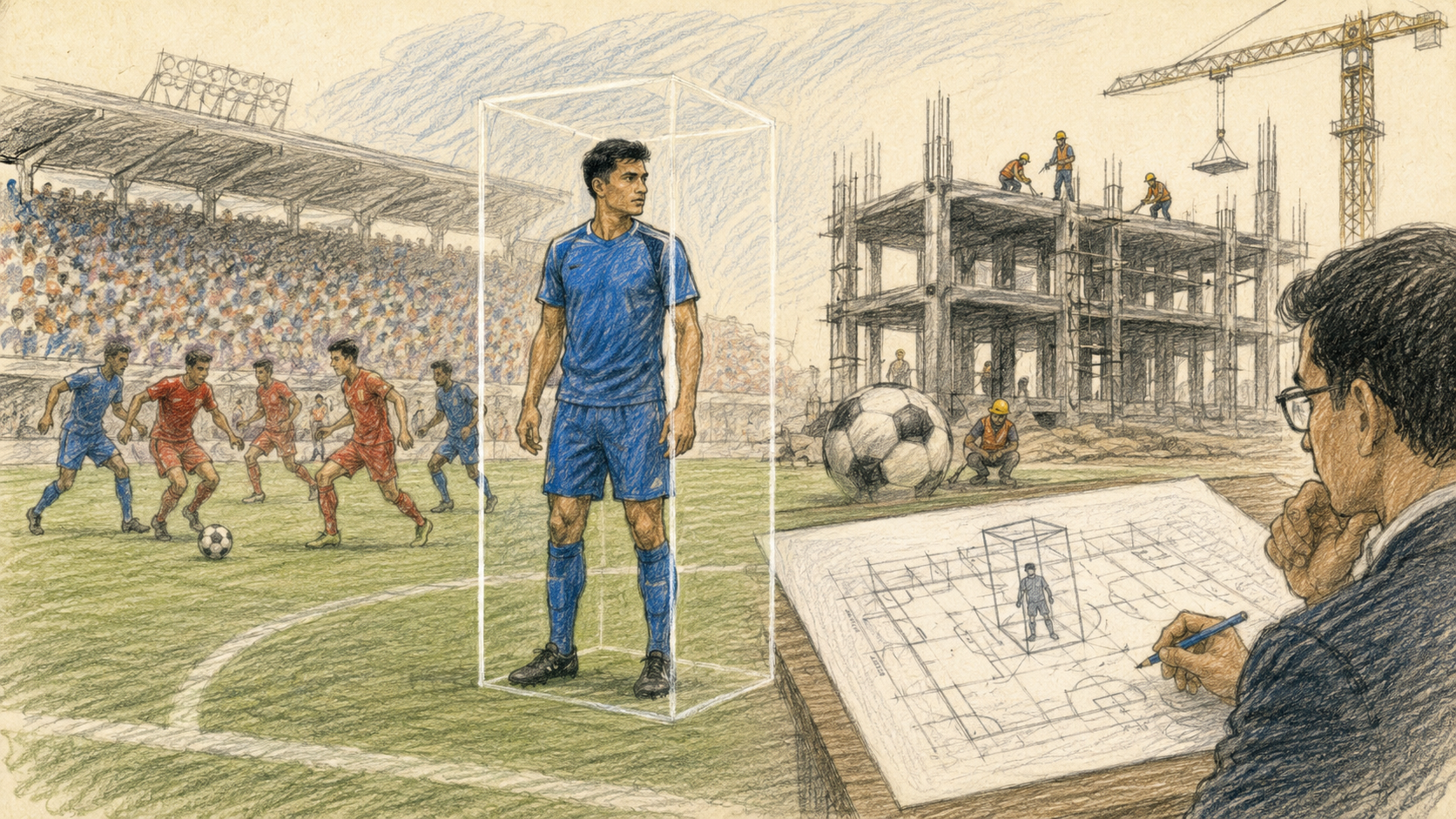
An Indian footballer standing isolated inside a glass box on the pitch during a match, with an architect's blueprint of the same scene on a drafting table beside a stadium construction site
The penalty area is a theater of fractions. To operate as an elite center-forward in the modern game is to exist in a state of permanent cognitive and physiological distress. When a cross is whipped into the eighteen-yard box, a striker has approximately 0.4 seconds to calculate the spatial geometry of the incoming trajectory, track the blind-side positioning of a 190-pound center-back, and execute a biomechanically flawless finish. This sequence demands an extraordinary synchronization of fast-twitch muscle fiber transitions (specifically Type IIx fibers for explosive acceleration) and instantaneous cognitive processing, all executed while the body is suffocating under the profound oxygen debt of anaerobic glycolysis.
Instinct, in the footballing lexicon, is not a mystical endowment; it is the subconscious optimization of these variables forged through thousands of hours of high-stakes, high-pressure repetition.
Yet, in the hyper-capitalist ecosystem of modern football, instinct has a price tag. And for emerging football economies, it has historically been cheaper to import it than to incubate it. For the past decade, the Indian Super League (ISL) has operated as a microcosm of global football’s free-market ruthlessness. Managers, driven by the existential threat of the sack and the mandate of immediate return on investment, have systematically outsourced the No. 9 role to proven foreign mercenaries.
Why risk a developmental domestic prospect when a veteran Spanish or Brazilian forward offers a guaranteed statistical floor? This economic reality created a tactical hegemony. The foreign import became the apex predator, while the domestic player was systematically reduced to functional, low-risk utility roles: the industrious wing-back, the destructive holding midfielder, the pressing winger. The Indian center-forward was facing structural extinction, culminating in a national team heavily reliant on a single, aging talisman in Sunil Chhetri, with a terrifying void in his shadow.
Faced with this demographic collapse, the All India Football Federation (AIFF) enacted a legislative sledgehammer: a mandate requiring ISL clubs to maintain at least one domestic striker on the pitch for the full 90 minutes of every match.
This is not a gentle structural nudge; it is a violent disruption of the free-market ecosystem. By dictating tactical composition from the boardroom, the governing body is staging an aggressive experiment in artificial evolution. The core hypothesis is both audacious and controversial: if you mandate the environment, can you force the genetic mutation of the domestic attacker?
To understand the gravity of this intervention, we must deconstruct the sport from its absolute foundational elements. Football is inherently Darwinian. A player’s place on the pitch is traditionally justified by merit, forged in the brutal crucible of daily training sessions structured around tactical periodicity. A manager cycles through intense macro-cycles of physical and tactical preparation, and the eleven players who emerge on matchday are the survivors of that week’s tactical natural selection.
Protectionism inherently short-circuits this evolutionary process. When a domestic striker knows that a starting berth is guaranteed by a passport rather than a superior expected goals (xG) output or pressing metric, the psychological architecture of the athlete fundamentally shifts.
The danger of the AIFF’s mandate is the creation of a "greenhouse ecosystem." In a free market, a young striker fighting for minutes against an elite, imported forward is subjected to immense adaptive stress. They must evolve their spatial awareness, their first touch, and their off-the-ball movement just to earn a ten-minute cameo. This stress induces athletic hypertrophy—both physical and mental. By removing the apex predator from the immediate competition for a starting spot, the AIFF risks lowering the threshold for survival.
Furthermore, the tactical ripple effects are profound. Modern football managers are architects of space. If a manager is forced to deploy a domestic No. 9 who lacks the elite hold-up play or the clinical biomechanics of a foreign counterpart, the entire structural integrity of the team’s attacking phase must be compensated. Managers may begin bypassing the center-forward entirely, utilizing them merely as a decoy to create space for inverted, goal-scoring foreign wingers. The domestic No. 9 risks becoming a tactical ghost—physically present on the pitch to satisfy a quota, but strategically isolated from the core offensive matrix.
Yet, there is a compelling, mathematically sound counter-argument to the free-market purists. Instinct cannot be refined if it is never tested under match conditions. The cognitive processing required to finish a chaotic rebound inside the six-yard box cannot be simulated in training; it must be experienced under the visceral, lactic-acid-inducing pressure of a live stadium.
By guaranteeing 90 minutes, the AIFF is providing domestic forwards with an unprecedented volume of data. Every duel against a towering foreign center-back, every missed near-post run, every intercepted through-ball becomes a vital node of neurological feedback. The human brain’s capacity for neuroplasticity means that repeated exposure to high-level game geometry will eventually accelerate cognitive processing. If a young Indian striker is repeatedly forced to navigate the claustrophobic confines of an ISL penalty box against elite defensive organizations, their fast-twitch responses and anticipatory reflexes will, theoretically, recalibrate to meet the required standard.
We have seen variations of this protectionist philosophy globally, with mixed results. The Chinese Super League’s infamous ban on foreign goalkeepers successfully birthed a generation of highly competent domestic shot-stoppers, proving that certain specialized roles can be incubated through legislative mandate. Conversely, artificial minutes mandates for U-22 players in various leagues have occasionally resulted in "tokenism," where players are substituted immediately after kick-off to satisfy the rule without compromising the tactical game plan.
The AIFF’s 90-minute stipulation effectively kills the tokenism loophole, forcing clubs to genuinely invest in the physiological and tactical development of their domestic forwards. The burden of production is forcefully shifted onto local academies. Clubs can no longer mask their developmental failures by writing a check to a 32-year-old European journeyman. They must now construct hyper-specific training regimens—optimizing the anaerobic thresholds and biomechanical finishing postures of Indian teenagers—because their very survival in the league depends on it.
In the end, the All India Football Federation has launched a fascinating, precarious socio-athletic experiment. Forced genesis is an inherently volatile process. The mandate will undoubtedly produce a short-term drop in the sheer aesthetic quality and clinical ruthlessness of ISL finishing. There will be agonizing misses, disjointed attacking phases, and the palpable frustration of managers constrained by legislative decree.
But the true measure of this policy will not be found in the immediate domestic league standings; it will be judged under the blinding lights of international competition. If, in five years, an Indian No. 9 peels off the shoulder of a seasoned Asian center-back, calibrates the trajectory of a low cross in a fraction of a second, and buries the ball in the roof of the net with cold, unthinking precision, the AIFF’s gamble will be vindicated. They will have proven that while the free market excels at unearthing greatness, the harsh, unforgiving greenhouse of the state can, occasionally, manufacture it.
More From The Field Weekly




Part of Issue 2: The Architecture of Belonging, published June 25, 2026→