table-tennis
The Tyranny of the Grid: When Bureaucratic Compliance Clashes with Global Excellence
The Table Tennis Federation of India's decision to bench Manika Batra for skipping domestic tournaments is a case study in federations punishing athletes for outgrowing them.
By Aditya Krishnan, Olympic Sports & Sporting Institutions · June 25, 2026 · 6 min read
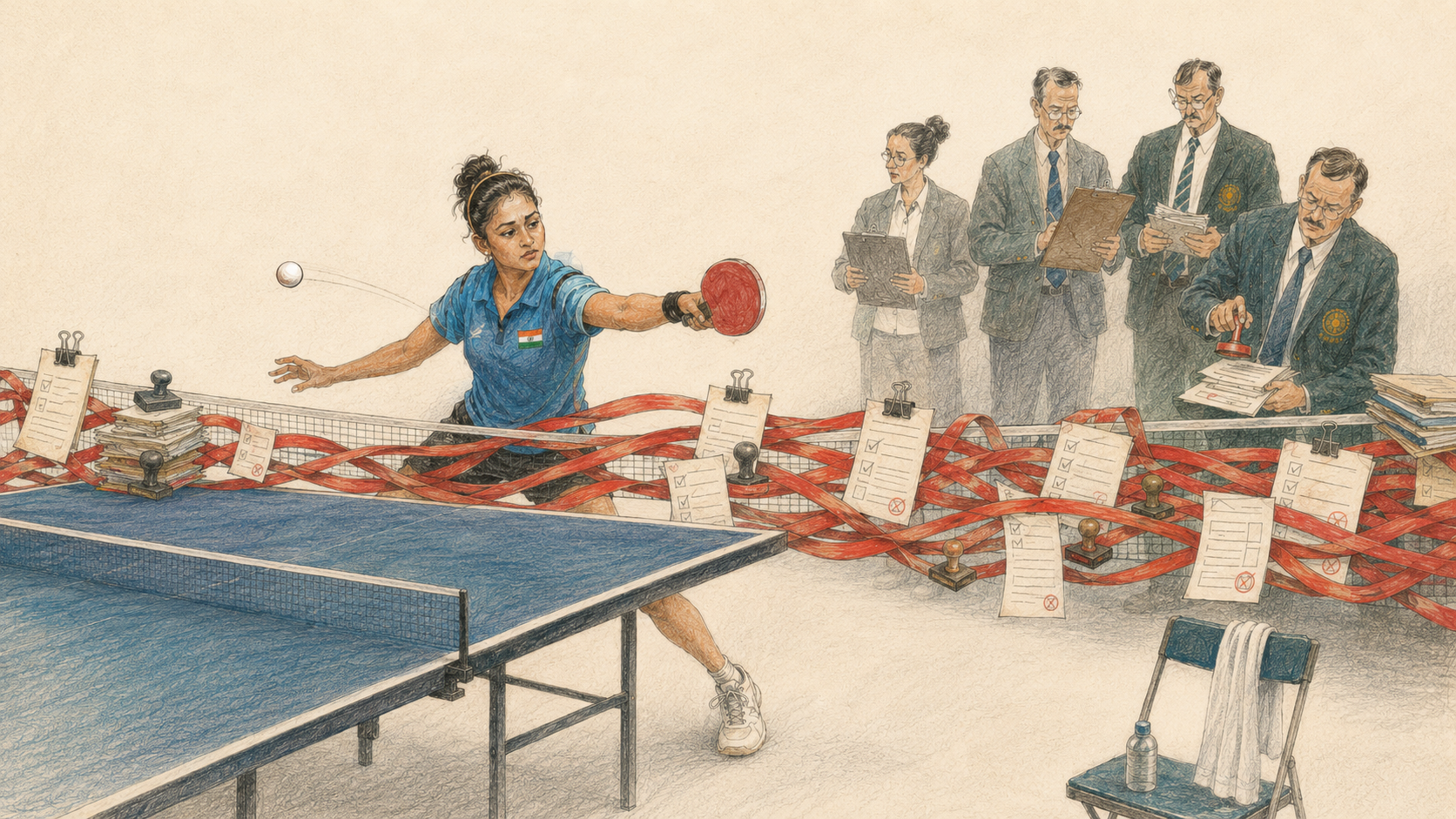
An illustration of Manika Batra playing a forehand at a table tennis table while a row of federation officials look on disapprovingly with clipboards
The Kinetics of the Table
Elite table tennis is a sport fundamentally hostile to margin of error. The polymer ball, struck by a composite blade laminated with tensioned rubber, frequently eclipses 100 kilometers per hour. At the professional table’s dimensions, an athlete operates within a neuro-muscular latency window of fewer than 150 milliseconds. To simply return a modern topspin loop requires instantaneous processing of the Magnus effect—where the aerodynamic force is dictated by the equation $F_M = S(\vec{\omega} \times \vec{v})$—and an immediate, subconscious calibration of the bat angle to within a fraction of a degree.
This environment demands absolute, uninterrupted kinetic specialization. It relies on the hyper-development of Type IIx fast-twitch muscle fibers, pristine anaerobic glycolysis to sustain explosive lateral footwork, and a psychological architecture built entirely around split-second pattern recognition. At the bleeding edge of the World Table Tennis (WTT) circuit, an athlete is no longer just a competitor; they are a finely tuned, highly specialized biomechanical instrument.
But instruments of this caliber require total optimization. Their training blocks, their recovery windows, and their competitive peaks are dictated by a concept known as tactical periodicity—a scientific structuring of load and recovery designed to ensure peak physiological output during global majors. To disrupt this periodicity is to shatter the athlete's optimization window.
Yet, in the spring of 2026, the Table Tennis Federation of India (TTFI) decided that administrative compliance was more critical than physiological optimization. By relegating Manika Batra—India’s most prolific, tactically idiosyncratic, and globally recognized paddler—to a reserve spot for the 2026 Asian Games roster due to her absence from mandatory domestic tournaments, the federation committed an act of bureaucratic self-sabotage. It was a stark manifestation of the Tyranny of the Grid: the overwhelming institutional anxiety that demands total control over individual athletic sovereignty, even if it means destroying the very exceptionalism the federation exists to cultivate.
The Illusion of the Provincial Metric
To understand the absurdity of the TTFI’s mandate, one must deconstruct the disparate realities of the domestic grid versus the global circuit. Manika Batra does not play a conventional game. She employs long pimpled rubber on her backhand, frequently "twiddling" (flipping the bat in her hand mid-rally) to disrupt the spin and pacing of her opponent. It is a game built on extreme variance, psychological disruption, and forcing errors from the world’s elite—specifically the aggressive, topspin-heavy Chinese and Japanese athletes who dominate the top 20 rankings.
Refining this hyper-specialized style requires constant exposure to global outliers. The domestic Indian circuit, while fundamentally important for grassroots development and talent identification, does not offer the velocity, the spin variance, or the tactical density required for a top-tier WTT athlete to maintain their edge. Mandating that an athlete of Batra’s caliber interrupt her international periodicity to return to India for provincial fixtures is not merely an inconvenience; it is a tactical regression.
When the TTFI penalizes Batra for prioritizing the WTT circuit, they are effectively demanding that she optimize for the bureaucracy rather than the podium. It is a failure to recognize that elite athletes are, in the modern era, multinational corporations of one. Their currency is global ranking points, their shareholders are international sponsors, and their operational directive is absolute global supremacy. The federation’s domestic grid, constructed decades ago when international travel was scarce and the sport was highly centralized, is an anachronistic framework trying to contain a modern, frictionless reality.
The Physiological Toll of Compliance
The friction between the athlete and the institution is not merely philosophical; it is deeply biological. Tactical periodicity dictates that an athlete’s year is divided into macrocycles (the overarching season), mesocycles (training blocks leading up to majors), and microcycles (the week-to-week load).
For an elite paddler based partially in Europe or navigating the Asian WTT hubs, flying back to India to participate in a mandatory domestic tournament introduces a catastrophic disruption to this periodicity. The physiological toll of long-haul travel across multiple time zones triggers severe circadian disruption, suppressing melatonin and elevating baseline cortisol levels. This hormonal cascade directly inhibits glycogen resynthesis and delays the repair of micro-tears in the muscle fascia.
More crucially for a table tennis player, circadian misalignment drastically increases neuro-muscular latency. When reaction times are measured in the hundredths of a second, an increase in latency of just 15 milliseconds—a standard byproduct of a six-hour time zone shift—is the difference between a perfectly executed counter-loop and a ball clipped off the edge of the blade.
By forcing Batra to conform to a rigid domestic calendar, the TTFI is biologically penalizing her. They are injecting fatigue, elevating her injury risk, and degrading her kinetic sharpness. The bureaucracy, designed in theory to support the athlete, functionally operates as a biological anchor, dragging down the very performance metrics it will later demand of her at the Asian Games.
The Institutional Friction and Bureaucratic Anxiety
Why, then, does a federation actively self-immolate by benching its primary medal contender? The answer lies in the sociology of institutional friction and the deep-seated anxiety of the developing sports federation.
Administrations like the TTFI derive their power from the illusion of absolute control. The "Grid"—the domestic calendar, the selection committees, the mandatory camps—is the mechanism through which that power is exercised. When an athlete achieves a level of global excellence that transcends the Grid, they become a threat to the institutional hierarchy. Batra’s primary relevance is no longer derived from being an Indian national champion; it is derived from being a top-tier international phenomenon who happens to carry an Indian passport.
This shift in gravity terrifies legacy bureaucracies. If an athlete does not need the domestic system to achieve global excellence, the system's foundational myth of meritocracy and necessity begins to crumble. To reassert relevance, the federation weaponizes compliance. The penalty leveled against Batra is not about fairness to domestic players who ground through the provincial circuit; it is an exercise in dominance. It is the federation violently pulling the leash to remind the greyhound who owns the track.
This dynamic is not unique to Indian table tennis. It is a systemic geopolitical friction seen across developing athletic nations, where the administrative apparatus matures much slower than the athletic talent it oversees. The federation views the athlete's sovereignty—their custom coaching staffs, their privatized sports psychology routines, their optimized WTT schedules—not as an asset to be leveraged, but as insubordination to be punished.
The Cost of the Grid
The relegation of Manika Batra to a reserve spot for the 2026 Asian Games is a profound institutional failure disguised as procedural integrity. It highlights a critical inflection point in the modern sporting landscape: the moment when the velocity of the elite athlete permanently outpaces the capacity of the provincial bureaucracy to govern them.
To demand that an athlete operating at the outermost limits of human biomechanical potential conform to a sluggish, one-size-fits-all administrative grid is to misunderstand the very nature of exceptionalism. Excellence is inherently non-compliant. It requires bespoke, asymmetrical, and often selfish optimization.
When a federation values the neatness of its spreadsheets over the sheer, terrifying kinetic power of its greatest talents, it ceases to be an engine for national glory. It becomes merely another opponent the athlete must defeat. And in the brutal, high-speed geometry of international table tennis, where matches are won and lost in the span of milliseconds, an athlete cannot afford to fight the ball, the opponent, and their own federation simultaneously.
More From The Field Weekly



Part of Issue 2: The Architecture of Belonging, published June 25, 2026→