fencing
The Borrowed Blade: Sporting Statecraft and the Architecture of Belonging
Hosting the Asian Fencing Championships in Delhi won India no medals — but it bought entry into a closed, aristocratic sport that has never had to take the country seriously before.
By Aditya Krishnan, Olympic Sports & Sporting Institutions · June 25, 2026 · 6 min read
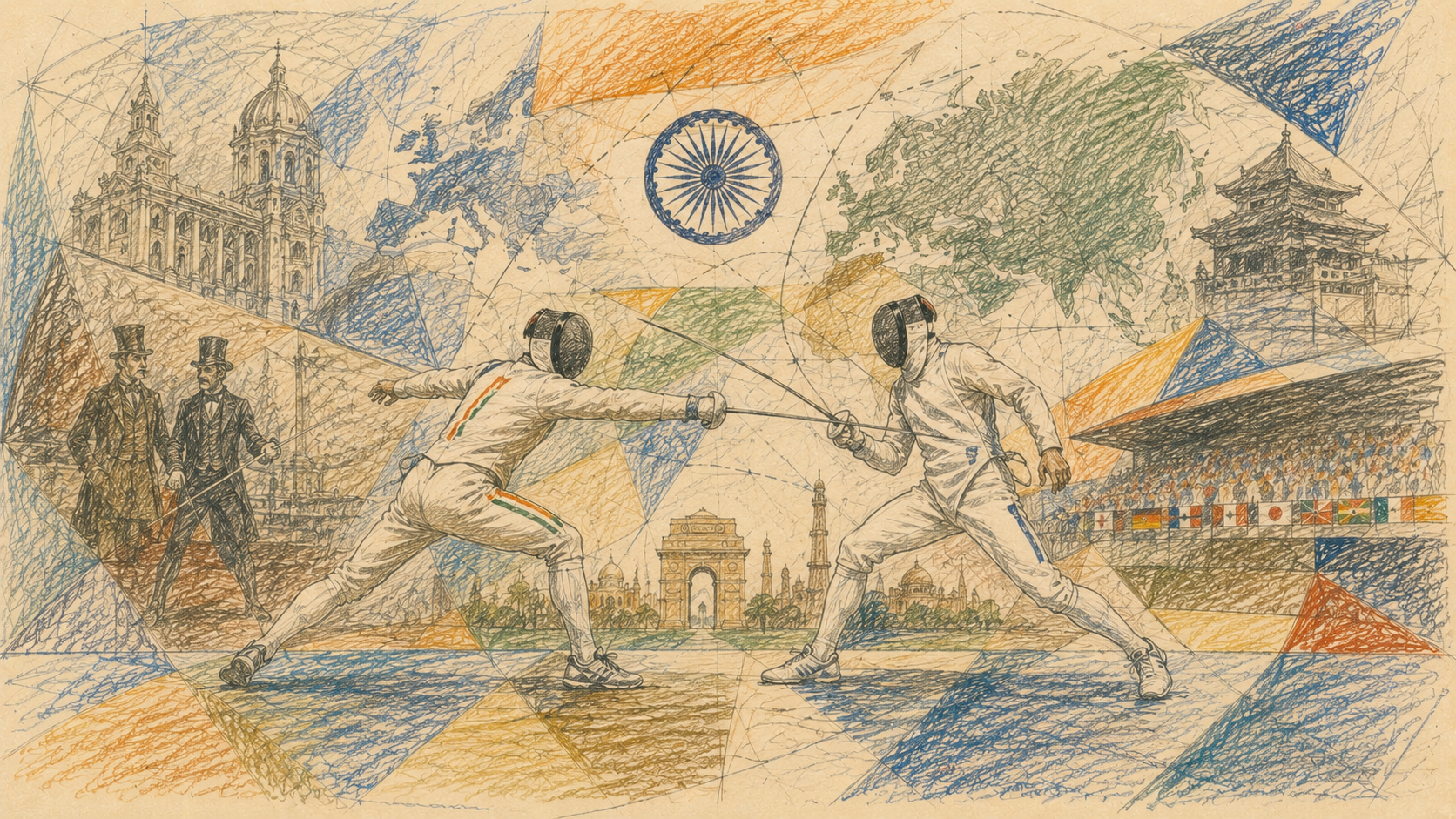
Two fencers lunging at each other on a piste in New Delhi, with India Gate, European architecture, and a Chinese pagoda illustrated in the background
The Architecture of the Piste
To walk into the host arena in New Delhi during the Asian Fencing Championships was to step across a geopolitical threshold. Outside, the subcontinent hummed with its native, chaotic thermodynamics—a relentless crush of humidity, traffic, and density. Inside the stadium, the atmosphere was violently arrested. The air was hyper-cooled, sterile, and silent, save for the sudden, piercing shrieks of the electronic scoring boxes and the metallic clack of maraging steel.
The floor was a geometric grid of fourteen-meter strips of conductive copper mesh. This is the piste. It is not merely a playing surface; it is an imported architectural boundary. Fencing is a sport defined by absolute linearity and rigid, binary outcomes. There is no spatial creativity, no playing the angles of a wide field. You advance, or you retreat. You strike, or you are struck.
For India to host a major continental championship in a discipline traditionally monopolized by Western European aristocracies and, more recently, hyper-engineered East Asian academies, was an act of profound sporting statecraft. The domestic fencing pipeline is still in its infancy; the hosts were not under the illusion of dominating the medal tables. Instead, the objective was entirely infrastructural. In the brutal economics of elite global sport, an emerging nation does not wait to be invited into the aristocracy. It buys the architecture, installs the apparatus, and forces the aristocracy to travel to its soil. This tournament was not an athletic competition for India; it was an exercise in geopolitical assimilation.
The Aristocratic Friction
Every sport carries the DNA of its origin. Wrestling and athletics are fundamentally democratic, born of the dirt and the basic human kinetic chain. Fencing is inherently oligarchic. It evolved from the lethal dueling codes of the French and Italian nobility, later morphing into a highly sanitized, electrified combat simulation that demands staggering financial capital.
Consider the sheer friction of importing this discipline. To equip a single elite fencer requires Kevlar-woven plastrons, conductive lamés woven with metallic thread, carbon-fiber masks, body wires, and weapons forged from aerospace-grade steel that snap and must be constantly replaced. To equip a tournament requires miles of spool cables, proprietary scoring algorithms, and raised metallic platforms.
By financing and executing this logistical nightmare, the Indian sporting apparatus was sending a deliberate message to the global athletic hegemony. Hosting the Asian Championships is the equivalent of paying the initiation fee to an exclusive country club. It demonstrates organizational bandwidth, capital liquidity, and a willingness to conform to the exacting, esoteric standards of the Fédération Internationale d'Escrime (FIE). The host nation is declaring that it no longer wishes to be viewed merely as a dominant force in indigenous or post-colonial sports like cricket or field hockey. It demands relevance in the precise, expensive disciplines that have historically served as the gatekeepers of Olympic prestige.
The Geopolitics of the Right of Way
To understand the metaphor of India's hosting strategy, one must understand the tactical engine of fencing itself—specifically in foil and sabre—which is governed by the "Right of Way" (Tactical Priority).
When two fencers lunge and strike each other simultaneously, the scoring apparatus registers two lights. However, the referee awards the point only to the athlete who initiated the attack, or the athlete who successfully parried an attack before riposting. You cannot score simply by touching the opponent; you must possess the geopolitical authority of the moment. You must establish your intention, seize the initiative, and force your opponent to react to your aggression.
For decades, the global south has lacked the Right of Way in the Olympic ecosystem. They have been reactive, competing in structures built, judged, and scheduled by Western capitals. By hosting the Asian Championships, New Delhi seized the Right of Way. They dictated the logistics. They commanded the timeline.
They also brought the world’s elite—the terrifyingly precise South Koreans, the tactically brilliant Japanese, the physically overwhelming Chinese—into their own time zone. In sports science, the disruption of circadian rhythms and the stress of international transit result in measurable drops in fast-twitch muscle fiber recruitment and central nervous system reaction times. Hosting is an act of subtle, legalized sabotage against the hegemony. It forces the masters of the sport to endure the friction of the host's geography, allowing the host’s developing athletes to compete with a localized, homeostatic advantage.
The Kinetics of Infiltration
The ultimate purpose of hosting, however, is not just administrative posturing. It is data acquisition. For the Indian fencers who took to the piste, the tournament was a massive, publicly funded laboratory. You cannot master the biomechanics of world-class sabre or épée by watching tape; you must feel the displacement of air when an elite opponent closes the distance.
The biomechanics of fencing are built entirely around the manipulation of distance and the explosive recruitment of the posterior chain. A standard fencing lunge requires the athlete to sit in the en garde position—a deep, isometric squat that places massive tension on the quadriceps and patellar tendons. The acceleration must be completely linear. When an elite South Korean sabreur initiates a lunge, they do not push off the front foot; they violently extend the rear leg, firing the gluteus maximus and gastrocnemius.
The physics of this movement are governed by a rapid transfer of kinetic energy, where the velocity $v$ of the weapon point is maximized by extending the arm before the front foot strikes the piste. If the foot lands before the arm extends, the kinetic chain is broken, and the mass $m$ of the body absorbs the shock rather than transferring it into the blade.
By fencing the Asian elite on home soil, Indian athletes were subjected to kinetic rhythms they had never experienced in domestic camps. They felt the micro-hesitations—the half-steps and broken tempos—used by the Japanese to trigger false reactions. They experienced the terrifying terminal velocity of a Chinese flèche attack. This is the infiltration protocol. You bring the best into your house, you lose to them, and in the process, you map their neuromuscular signatures.
Tactical Periodicity and the Long Horizon
In sports science, "tactical periodicity" refers to the long-term, cyclic structuring of training to peak at a specific future moment. New Delhi's hosting of the event must be viewed through this macroeconomic lens.
The Indian fencers who suffered early-round exits on the copper pistes were not failing; they were serving as the foundational data points for the next generational cycle. Their defeats highlighted the exact biomechanical and tactical deficits—reaction time latency, poor distance management, inadequate isometric endurance in the en garde stance—that the domestic coaching apparatus must now reverse-engineer.
The Resonance of the Blade
When the Asian Fencing Championships concluded, the medals inevitably departed for Seoul, Tokyo, and Beijing. The podiums reflected the established, uncompromising hierarchy of the sport. But to judge the event by the medal table is to misread the mechanics of geopolitical ambition.
When the stadium lights dimmed and the foreign delegations flew home, the copper pistes remained. The electronic scoring boxes remained. The institutional knowledge of how to organize, officiate, and maintain the complex architecture of an aristocratic combat sport remained embedded in the host city.
New Delhi did not conquer Asian fencing over those few days, but it fundamentally altered its relationship to the sport. The host nation ceased to be a spectator from the periphery. By laying down the piste and holding the world to its boundaries, India executed a flawless act of sporting statecraft. They proved that before a nation can hope to wield the blade on the global stage, it must first prove it is capable of building the arena. The architecture of belonging is now in place; the mastery of the kinetic chain will follow.
More From The Field Weekly

Part of Issue 2: The Architecture of Belonging, published June 25, 2026→