shooting
The Centering of the Crosshair: Reclaiming Form in the Shadow of Olympic Scars
Elavenil Valarivan’s opening-day double silver in Nagoya was a study in physiological recalibration — shooting through the pulse rather than fighting to stop it.
By Aditya Krishnan, Olympic Sports & Sporting Institutions · September 24, 2026 · 5 min read
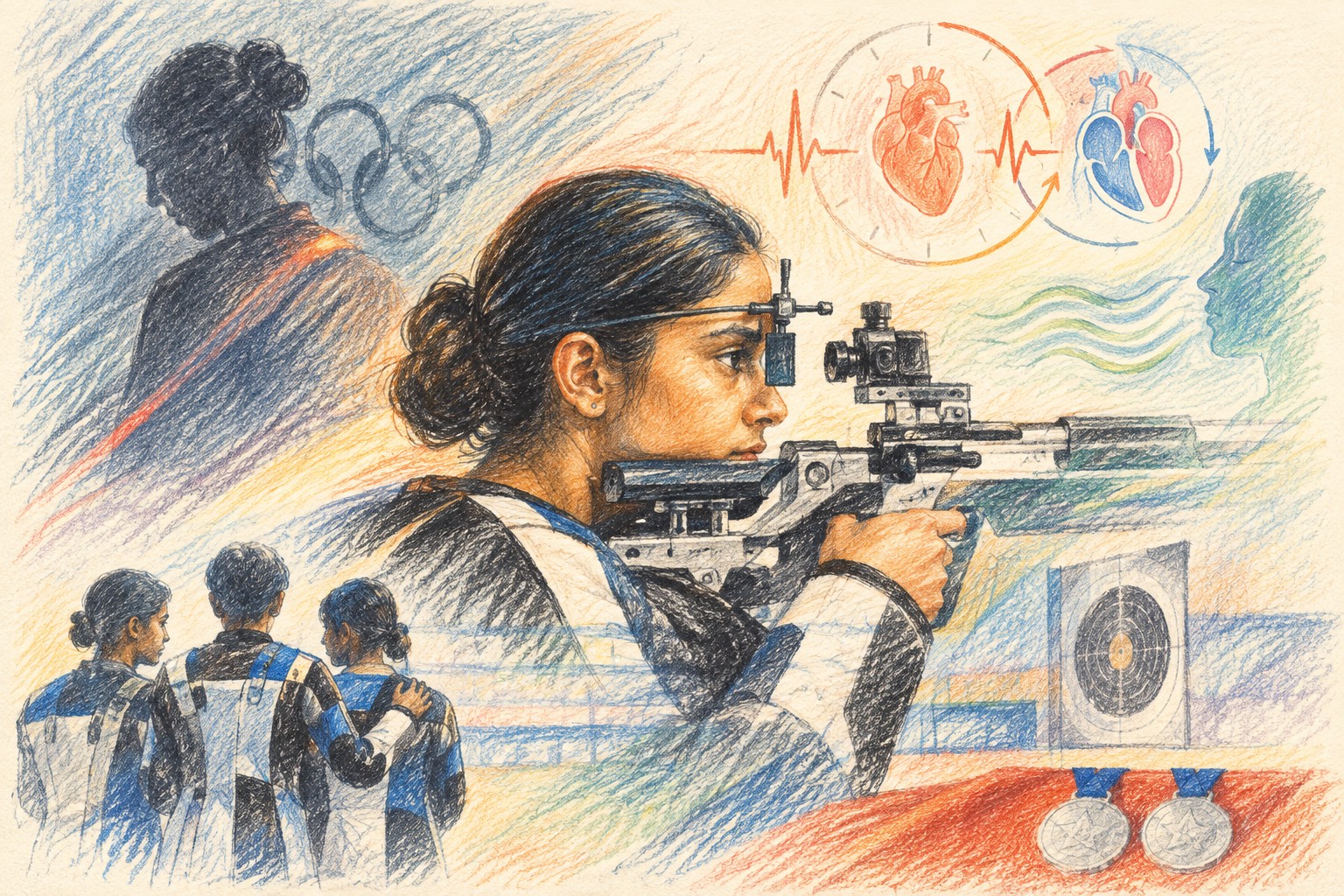
Elavenil Valarivan aiming her air rifle during the 10m air rifle final at the Asian Games
NAGOYA — The target dot at the center of an Olympic 10-meter air rifle range is 0.5 millimeters wide. It is roughly the diameter of the period mark at the end of this sentence. To score a maximum 10.9, an athlete standing ten meters away must send a 4.5mm lead pellet cleanly through that invisible prick of space.
At that resolution, human physiology becomes an active enemy. The rhythmic pumping of the aorta against the chest wall moves the barrel by three millimeters. The expansion of the lung cavity lifts the sights by four. Even the gentle twitch of a facial muscle or a sudden surge of adrenaline can throw a shot from a 10.8 down into a catastrophic 9.9.
For the past five years, Elavenil Valarivan had been fighting those biological enemies, and losing.
Once hailed as the heir apparent to Indian rifle royalty, Valarivan’s career had been defined by a baffling, painful paradox: untouchable world-record brilliance at ISSF World Cups, followed by catastrophic, frozen collapses on the Olympic stage. In Tokyo and Paris, the pressure of the moment had visibly seized her nervous system. She was the shooter who couldn't breathe when the stadium lights got too bright.
On the opening morning of the 20th Asian Games at the Aichi Rifle Range, Valarivan finally laid those ghosts to rest.
She shot with iron composure, securing individual silver in the women’s 10m air rifle final with a score of 252.1, just 0.3 points behind China’s teenage prodigy, after having already anchored the Indian trio (alongside Sonam Maskar and Vidarsa Vinod) to a team silver earlier in the morning.
It was not a story of guts or national pride. It was a clinical demonstration of autonomic nervous system re-engineering.
The Anatomy of the Olympic Freeze
To understand how Valarivan rebuilt herself, one must first deconstruct the mechanics of shooting panic.
When an athlete experiences severe competition anxiety, the sympathetic nervous system activates what neuroscientists call the "fight-or-flight" cascade. Epinephrine floods the bloodstream. The heart rate accelerates, peripheral blood vessels constrict, and micro-tremors begin in the fine motor muscles of the fingers and wrists.
For a sprinter or a boxer, this adrenaline dump is a performance enhancer. For a precision rifle shooter, it is an absolute death sentence.
In previous Olympic finals, Valarivan had attempted to fight this surge through pure cognitive suppression: trying to force her heart to slow down, holding her breath at the bottom of the exhalation, trying to "will" the crosshair into immobility.
This approach invariably leads to carbon dioxide buildup in the blood, which triggers involuntary diaphragm twitches. The longer she held her aim waiting for the sights to settle, the more her stability deteriorated. She was pulling the trigger not when the sight picture was perfect, but when her oxygen-starved brain could no longer tolerate the delay.
Shooting Through the Beat
The breakthrough that unlocked Valarivan’s Nagoya campaign was the total abandonment of the myth of total stillness.
Working with sports biomechanists and autonomic biofeedback coaches over the past eighteen months, Valarivan adopted a technique known in military precision marksmanship as "cardiac cycle timing."
A human heart does not beat continuously; it beats in a rhythm of systole (contraction) and diastole (relaxation). During the diastolic pause—the brief interval between the "lub" and the "dub" of the heartbeat—the thoracic cavity settles, blood pressure in the extremities drops momentarily, and the micro-vibrations in the upper body subside to near zero.
Instead of trying to eliminate her pulse, Valarivan learned to map it. Using optical sensors clipped to her earlobe during training, she conditioned her index finger to initiate the trigger squeeze exclusively within that 0.35-second diastolic window.
Watch the tape of the Nagoya final: her cadence was rhythmic, almost musical. She did not linger on the target. She lifted the rifle, took two deep diaphragmatic breaths, settled her cheek onto the cheekpiece, and broke the shot within 4.2 seconds of entering the aim.
She was no longer waiting for her body to stop shaking. She was shooting between the tremors.
The Youth Dynamic: The New Indian Battery
Equally significant was the composition of the team that took silver beside her.
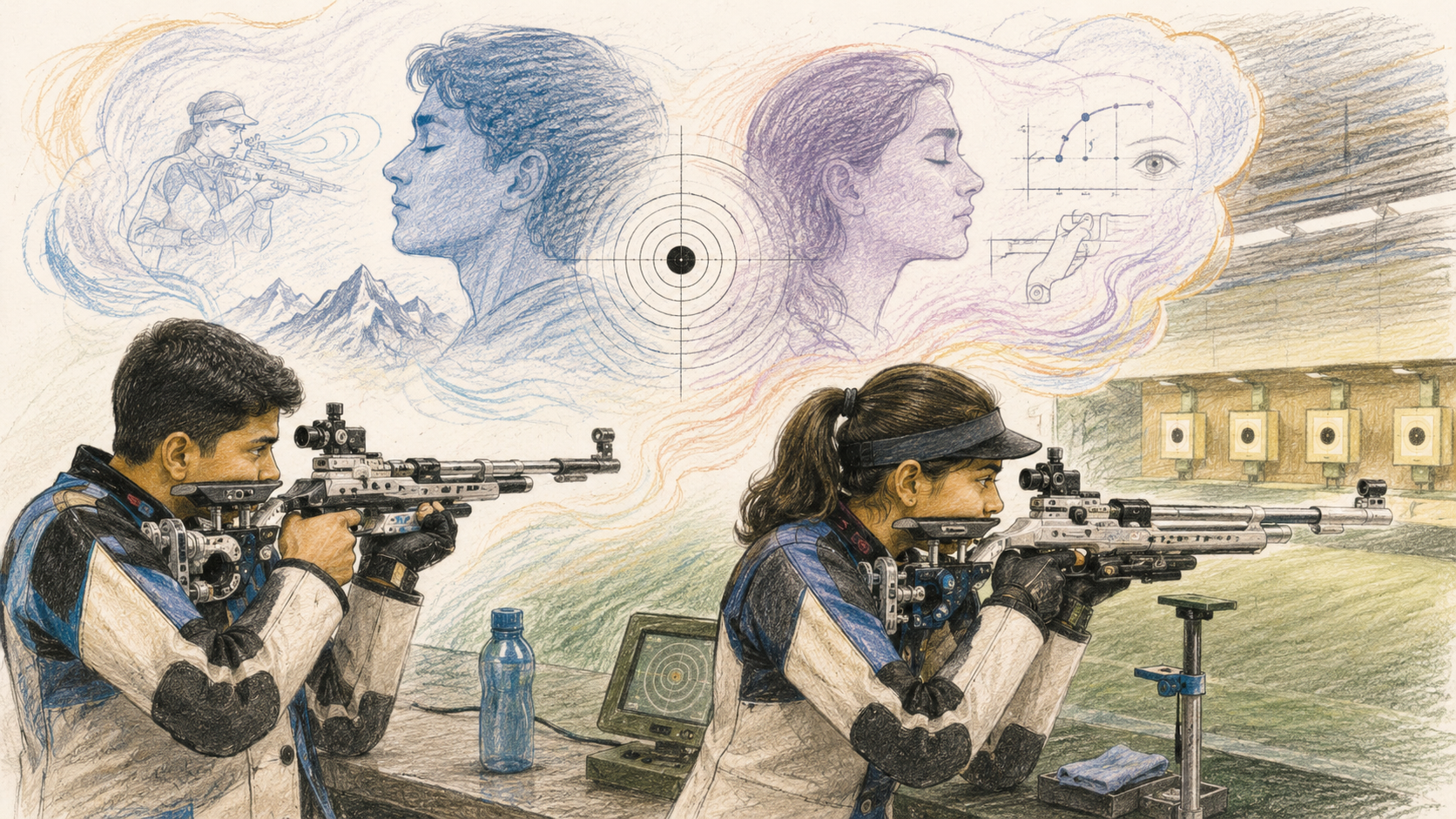
In past cycles, the Indian women’s rifle squad felt fragile because it was top-heavy—relying entirely on one or two marquee names who bore the psychological weight of the entire federation. In Nagoya, Valarivan was flanked by eighteen-year-old Sonam Maskar and nineteen-year-old Vidarsa Vinod.
These young shooters represent the second generation of India’s private shooting academies. They have grown up shooting on electronic target monitors since childhood, untouched by the historical baggage of India’s Olympic failures.
In the qualification rounds, when Valarivan dropped a rare 10.1 in her fourth series, Maskar immediately covered the deficit with a blistering 106.2 series on the adjacent lane. The pressure was distributed, not concentrated. For the first time in her senior career, Valarivan was not an isolated savior; she was the veteran anchor of a self-sustaining system.
The True Measurement
The final in Nagoya was won by China by a razor-thin margin of 0.3 points. In the medals table, it will go down as a silver.
Yet, for Indian shooting, this silver is worth vastly more than a dozen easy World Cup golds won in half-empty ranges in Cairo or Baku. It demonstrated that Indian precision athletes can enter the high-voltage arena of a major multi-sport games, look their own physiological panic in the eye, and dismantle it with scientific method.
The crosshair will always wander. The pulse will always race. The triumph in Nagoya is that Elavenil Valarivan has finally stopped demanding that her body be a machine, and learned how to make human imperfection shoot straight.
More From The Field Weekly
Part of Issue 3: The Friction of Ascent, published September 24, 2026→