athletics
The Cost of the Plant Foot: The High-Tonnage Reality of the Modern Javelin
Neeraj Chopra’s season-ending ankle ligament injury ahead of the Asian Games is not bad luck — it is the inevitable tax exacted on a joint absorbing eight times a thrower’s body weight in half a stride.
By Aditya Krishnan, Olympic Sports & Sporting Institutions · September 24, 2026 · 5 min read
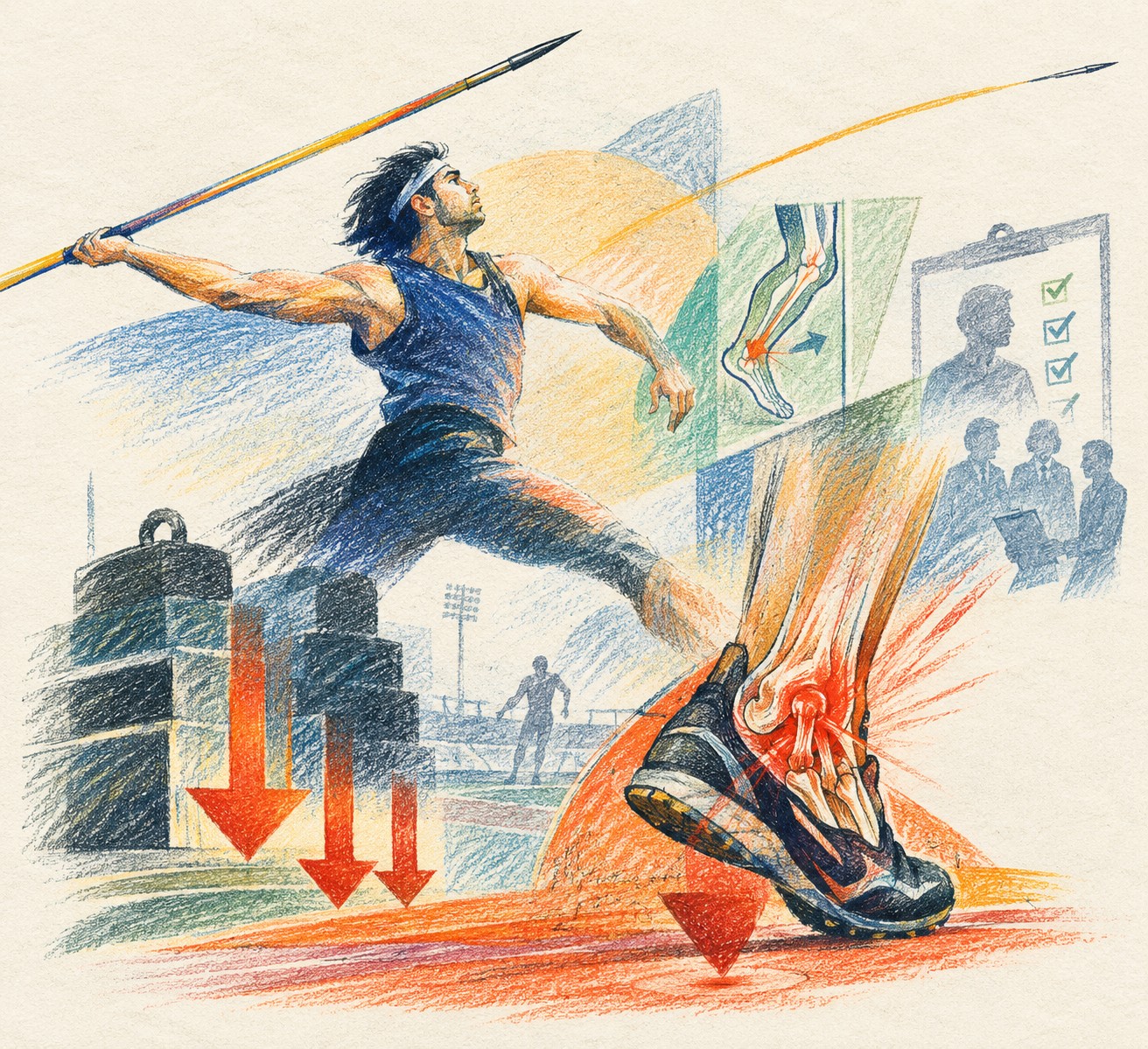
Neeraj Chopra executing the plant foot block on a synthetic javelin runway
BRUSSELS — When the press release arrived in mid-September confirming that Neeraj Chopra would miss both the Diamond League Final in Brussels and the 20th Asian Games in Aichi-Nagoya, the public reaction followed an exhausted Indian script. There were laments of national misfortune, anxious inquiries into whether he would recover for the next cycle, and whispers about whether an athlete who has given India two Olympic medals was beginning to succumb to the erosion of time.
This discourse treats athletic injury as an act of god—an unpredictable lightning strike that happens to good athletes on bad days.
The reality, visible only when you slow down high-speed cinematic footage to five hundred frames per second, is far less romantic and vastly more terrifying. Neeraj Chopra’s ankle ligament injury is not bad luck. It is the cold, calculated invoice presented by Newtonian mechanics. It is the biological tax demanded by an event that requires a human skeleton to act like a hydraulic crane dropping anchor at twenty-five kilometers per hour.
The Mechanical Absurdity of the Block
To throw an 800-gram carbon-composite javelin beyond eighty-five meters, an athlete does not throw with their arm. The shoulder and elbow are merely the whip; the engine is the run-up, and the transmission is the front leg.
Consider the physical sequence: Chopra accelerates down the runway, building linear velocity across twenty to thirty meters. In his penultimate crossover steps, he tilts his pelvis backward, leaning his torso away from the target to create maximum elastic stretch across his abdomen and chest.
Then comes the "block."
His left heel strikes the synthetic track with his knee almost completely locked out. In that instantaneous microsecond—roughly forty milliseconds—the athlete must arrest all forward momentum. The ground reaction force recorded on modern force plates during an elite javelin block can reach up to ten times the athlete’s body weight.
For a thrower weighing ninety kilograms, that equates to nearly nine hundred kilograms—almost a full metric ton of force—driving straight through the calcaneus (heel bone), reverberating across the talocrural joint, and stressing the anterior talofibular and calcaneofibular ligaments of the ankle.
If the knee bends even five degrees during this collision, the kinetic energy bleeds harmlessly into the quadriceps, and the javelin floats meekly to seventy-eight meters. To hit ninety meters, the leg must remain an unyielding steel pillar. The entire momentum of the body is violently converted into rotational whip over the braced left hip.
Every time Chopra throws, he is betting his connective tissue against the structural integrity of the synthetic track. Eventually, the track always collects its debt.
The Anatomy of Cumulative Micro-Trauma
Ligament tears in elite throwers rarely happen in a vacuum of a single catastrophic twist. They are the climax of cumulative micro-trauma.
Throughout the 2026 season—from the season opener in Doha through the mid-summer Diamond League fixtures in Lausanne and Paris—Chopra’s approach had become increasingly aggressive. The international throwing landscape has compressed. Germany’s Julian Weber, Czech star Jakub Vadlejch, and Pakistan’s Arshad Nadeem have pushed the baseline requirement for victory well into the eighty-eight-meter territory.
To maintain podium supremacy without an over-reliance on elbow strain (the site of Chopra’s 2019 surgery and recurrent soreness), his coaching setup shifted more of the mechanical burden toward runway velocity. He was running faster into the checkmarks.
Higher runway speed creates higher release velocity, but it increases ground braking forces exponentially. The talus bone repeatedly slams into the tibial mortise; the lateral ligaments stretch to their microscopic plastic limits. When an ankle has absorbed tens of thousands of these explosive braking impacts across a decade of elite competition, the collagen fibers lose their baseline elasticity. A slight variance in turf moisture, a millimeter of footwear slippage, or a fraction of a degree in foot angle on touchdown is all it takes for the tissue to finally shear.
The Administrative Blindspot: Managing National Treasures
Chopra’s withdrawal exposes a deeper structural flaw in how Indian sports governance treats its generational champions.
In Western European throwing federations—most notably in Germany and Finland—athletes operate inside an ecosystem of hyper-specialized load monitoring. German throwers use daily isometric force tests and wearable shear sensors on their ankles and knees. When joint stiffness drops below a critical threshold or tendon micro-inflammation spikes, the athlete is pulled from competition weeks before a tear occurs, regardless of whether a marquee meet is on the schedule.
In India, the athletic machinery remains intensely transactional. Every meet is framed as a mandatory theater of national prestige. The pressure to contest every Diamond League leg, attend domestic qualification trials, and headline continental multi-sport games is unrelenting.
Federations and fans celebrate Chopra’s indomitable competitive will—the way he famously threw with adductor strains in Budapest or back stiffness in Zurich. We romanticize the suffering. But sports medicine does not care about national heroism. Connective tissue has a biological yield point. When that yield point is crossed, the athlete is sidelined, and the system acts bewildered.
The Necessity of the Void
The silence left by Chopra’s absence at the Asian Games in Nagoya will be deafening. He has been the sun around which the entire solar system of modern Indian Olympic optimism has revolved since Tokyo 2021.
Yet, this enforced pause may be the most crucial development of his second act. At twenty-eight years old, Chopra’s biological runway is no longer limitless. If he is to contend at the Los Angeles Olympics, his training and competition calendar must undergo a radical demilitarization. He cannot be an all-weather showpiece for every federation demand.
Rebuilding the ankle is not merely a matter of orthopedic surgery and physiotherapy; it requires a structural reckoning with how Indian sports stewards its rare geniuses. The plant foot took the hit so that the javelin could fly. The question now is whether the system that celebrated every meter of that flight is willing to give the joint the time it needs to heal.
More From The Field Weekly
Part of Issue 3: The Friction of Ascent, published September 24, 2026→