athletics
The Kinetic Threshold: The Biomechanics of Crossing 19 Meters
Samardeep Singh Gill’s 19.59m throw at the Indian Athletics Final Series finally breached the barrier that stood in his way in June — not by adding muscle, but by rewiring the rotational kinetic chain.
By Rohan Desai, Track & Field · September 24, 2026 · 5 min read
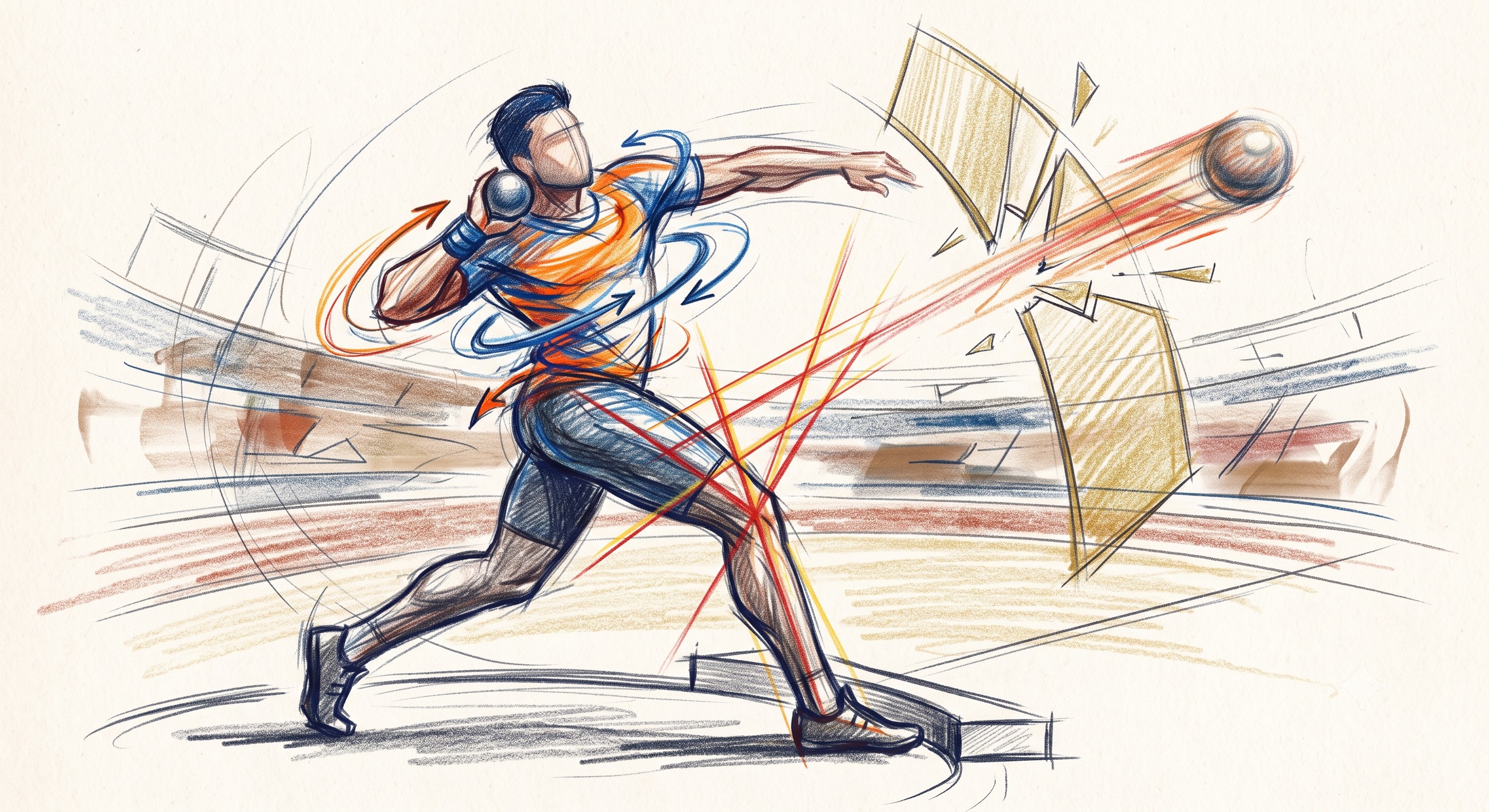
Indian shot putter Samardeep Singh Gill in mid-spin at the Jawaharlal Nehru Stadium in New Delhi
NEW DELHI — In the sport of shot put, nineteen meters is not merely a distance; it is a border checkpoint. Below nineteen meters, an athlete is a formidable domestic competitor, capable of dominating national invitationals and winning regional medals through raw physical conditioning and natural leverage. Above nineteen meters, however, the physics changes. The event ceases to tolerate even the slightest dissipation of momentum. Every millimeter gained is an exercise in microscopic torque and ruthless neuromuscular timing.
When Samardeep Singh Gill stepped into the 2.135-meter concrete circle at the Jawaharlal Nehru Stadium on September 10 for the Indian Athletics Final Series, he was carrying the ghost of early June. At the Balewadi Stadium in Pune three months earlier, Gill had recorded a 18.64-meter throw. It was an impressive mark, but it left him thirty-six centimeters short of the international standard—stranded in that frustrating, purgatorial zone where brute power reaches its absolute physiological ceiling.
On a warm Delhi evening under the floodlights, Gill broke through the tollbooth. His implement struck the turf at 19.59 meters, finishing second only to two-time Asian champion Tajinderpal Singh Toor (20.64m).
The ninety-five-centimeter leap from Pune to New Delhi was not achieved by spending more hours under a squat rack. You do not bench press your way past nineteen meters. Gill’s transformation was a textbook masterclass in the quiet redesign of the kinetic chain.
The Tyranny of the Transition
To understand what Gill fixed, one must examine the rotational technique's most treacherous quarter-second: the transition phase.
In rotational shot put, the athlete’s body functions as an organic whip. The movement initiates at the back of the circle, where the thrower winds up and sweeps their right leg across the center to generate angular momentum. The objective is to build speed in the lower limbs while keeping the upper torso and the 7.26-kilogram shot lagged as far behind as possible.
In June, Gill suffered from a subtle energy leak at the center of the ring. High-speed kinematic tracking revealed that when his right foot made contact with the concrete in the middle of his spin, his left arm was opening prematurely.
In the language of biomechanics, he was bleeding separation. Imagine wringing out a thick, soaked towel: to create maximum tension, the bottom half must rotate in one direction while the top half remains firmly anchored in the other. If the top half starts unwinding before the bottom half is fully locked, the coiled elastic energy stored in the thoracic spine and oblique abdominal muscles collapses.
In Pune, Gill was unwinding his towel too soon. Because his chest was turning toward the sector before his left foot could establish its final grounding, he was forced to arm-push the shot. His pectoral and deltoid muscles were doing the work that should have been executed by his quadriceps and glutes.
Between July and early September at the National Camp, Gill’s coaching staff overhauled his central plant mechanics. High-speed 240-frames-per-second footage reveals that in Delhi, Gill’s right foot grounded with his shoulders rotated a full 112 degrees away from the throwing vector. He held that tension for twelve hundredths of a second longer than he had in June. He turned his torso into a pressurized industrial spring.
The Physics of the Left Wall
Holding the spring, however, is useless unless you have a brick wall to release it against. In throwing events, that wall is called "the block."
When a thrower completes their central rotation, their left foot plants firmly at the front toe-board. The left side of the body must lock out instantly, acting as a rigid fulcrum. The principle is identical to a speeding car crashing into a concrete barrier: the chassis stops dead, but an unrestrained object inside the car is violently projected forward through the windshield.
In Gill’s 19.59m throw in Delhi, the deceleration of his left hip was near-instantaneous. Force-plate data from modern training circles illustrates that the ground reaction force during this braking phase can exceed four times an athlete's body weight.
By arresting his left-side rotational velocity in less than 0.08 seconds, all the linear and rotational momentum generated from the back of the ring had only one path of escape: upward and outward through his right shoulder, down the arm, and into the shot.
The release velocity jumped from approximately 13.2 meters per second in Pune to over 13.8 meters per second in Delhi. In projectile physics, where range is proportional to the square of launch velocity, a four percent increase in release speed yields a disproportionately massive leap in distance. Those fractions of a meter per second were the exact mathematical difference between 18.64m and 19.59m.
The New Architecture of Indian Power
For decades, Indian track and field was dominated by a fatalistic acceptance of physiological limits. We conceded the heavy field events—the shot, the discus, the hammer—to the monolithic builds of Eastern Europe and North America, retreating into the romanticism of middle-distance grit or the nimble leverage of the javelin.
The emergence of Gill alongside Tajinderpal Singh Toor disproves that dogma. Gill does not possess the towering 6-foot-7 frame of an American collegiate champion. Instead, his 19.59m throw represents the democratization of power through biomechanical fidelity. When technique is optimized to this degree, rotational acceleration compensates for raw physical mass.
Tajinderpal Singh Toor’s victory at 20.64m at JLN Stadium proved that the veteran standard remains formidable. But Toor is no longer throwing in an echo chamber. For the first time in Indian athletics history, two domestic shot putters are exchanging throws in the upper nineteenth and twentieth meters on the same evening.
Nineteen meters is no longer an exotic foreign destination. It is the baseline requirement. And as Samardeep Singh Gill proved in Delhi, once you learn the physics of the circle, gravity is no longer an adversary—it is simply another variable to be calculated.
More From The Field Weekly

Part of Issue 3: The Friction of Ascent, published September 24, 2026→