para-sport
The Redefinition of Capacity: Youth, Adaptation, and the Mechanics of the Future
India's 27-medal sweep at the World Abilitysport Youth Games wasn't a story of overcoming adversity — it was a demonstration of bioengineering, built on a neuroplasticity unique to adolescent athletes.
By Rohan Desai, Track & Field · June 25, 2026 · 6 min read
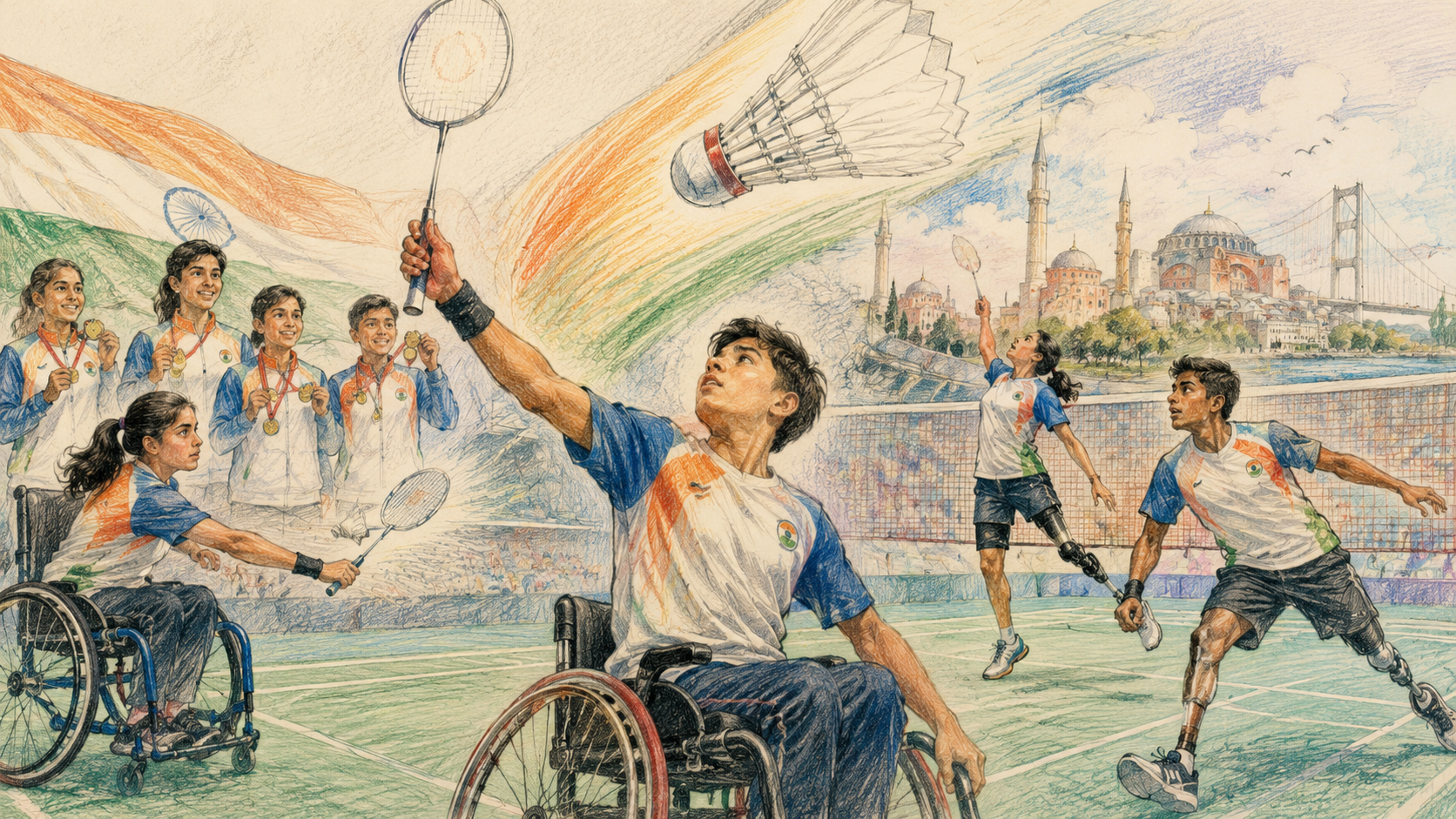
Young Indian para-athletes playing wheelchair badminton and running with prosthetic blades, with teammates celebrating with medals in the background and a mosque skyline behind them
The End of the Inspiration Era
To watch the World Abilitysport Youth Games through the lens of pity, or even conventional inspiration, is to fundamentally misunderstand the physics unfolding on the track and in the field. When the Indian para-athletic contingent dismantled international competition to secure a staggering 27 medals, the mainstream narrative inevitably fell back on exhausted tropes: overcoming adversity, fighting the odds, the triumph of the human spirit.
This framing is not only patronizing; it is scientifically illiterate.
The young athletes who stood on those podiums are not operating at a deficit, nor are they merely "compensating" for anatomical anomalies. They are the vanguard of human bio-engineering. To sprint with a carbon-fiber blade, to hurl a javelin from a seated throwing frame, or to navigate the violent, high-speed geometry of wheelchair track events requires a fundamental rewiring of the mammalian motor cortex. It demands the conscious construction of asymmetrical kinetic chains that able-bodied athletes never have to conceive.
India’s 27-medal haul is an architectural revelation. It signals the maturation of a domestic pipeline that has finally shifted from producing accidental champions to engineering systemic, high-performance phenomena. These youth athletes are not striving to mimic standard human movement; they are actively rewriting the absolute limits of capacity, proving that performance optimization is no longer about perfecting the baseline human form, but about mastering its radical adaptation.
The Architecture of Asymmetrical Torque
In traditional sports science, biomechanics is a study of symmetry. Power generation relies on the bilateral transfer of Ground Reaction Forces (GRF) originating from two feet, traveling up through the kinetic chain of the hips, spine, and shoulders. But what happens when that chain is structurally severed?
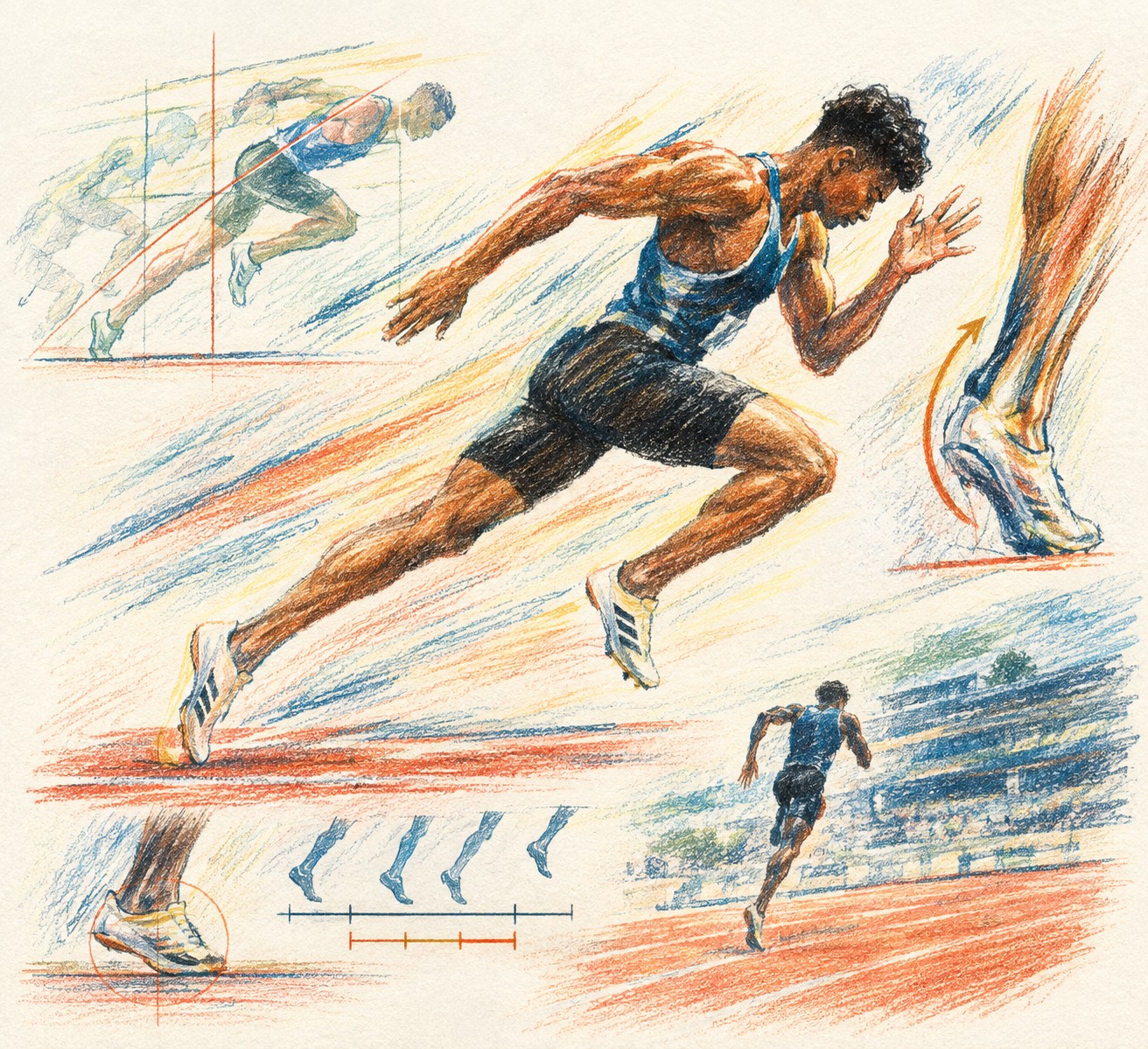
For a para-athlete with a lower-limb amputation or cerebral palsy, the standard laws of biomechanical leverage are voided. They must invent new physics. Consider a T42 or T63 sprinter. During the drive phase of a sprint, an able-bodied athlete utilizes the explosive triple-extension of the hip, knee, and ankle. A para-athlete utilizing a prosthetic blade must generate equivalent forward velocity without a biological ankle or calf muscle to provide plantar flexion.
Instead, they rely on a violently optimized gluteus maximus and hip flexor on the amputated side to drive the carbon-fiber blade into the tartan track, forcefully compressing the synthetic polymer. The blade stores this kinetic energy and releases it. But managing this "hysteresis"—the fractional loss of energy between compression and release—requires hyper-precise pelvic stabilization. Because the blade does not have proprioceptive nerve endings, the athlete’s central nervous system must map the behavior of dead carbon through the somatosensory feedback of the residual limb's socket.
The Indian youth contingent demonstrated an elite mastery of these engineered mechanics. Their coaches are no longer treating amputations or neurological variances as injuries to be routed around; they are treating them as unique mechanical platforms to be optimized. They are building athletes from the ground up, utilizing asymmetrical resistance training to fortify the specific, localized muscles required to control synthetic limbs and customized throwing frames.
Neuroplasticity and the Juvenile Cortex
The fact that this dominance occurred at a Youth Games is the critical variable in the equation. The human brain is infinitely malleable, but during adolescence, neuroplasticity is at its absolute zenith.
When an adult loses a limb, their motor cortex has already spent decades mapping a bilateral body. Introducing a prosthetic requires unlearning a lifetime of neural pathways. But when a 14-year-old athlete is integrated into an elite para-sports pipeline, their developing brain assimilates the adaptive equipment not as an external tool, but as an anatomical extension of the self.
This is a form of cognitive osseointegration. The youth athlete’s brain constructs new neural pathways to process the exact stiffness coefficient of their racing wheelchair or the specific flex of their running blade. When an Indian junior wheelchair racer strikes the push-rims at 20 miles per hour, they are not gripping the wheel—which would waste milliseconds and invite friction—they are executing a precise, percussive "punch" mechanism against the rim. The timing of this strike, coordinated with the pendulum swing of the torso, requires a neurological rhythm that borders on the superhuman. Because these athletes are young, their nervous systems encode these highly unnatural, hyper-efficient movement patterns as native mechanics.
The Metabolic Tax of the Non-Standard Body
To appreciate the gravity of these 27 medals, one must understand the hidden physiological toll of para-athletics: the metabolic tax.
Human bipedalism is an evolutionary marvel of energy conservation. When the body's symmetry is altered, the metabolic cost of locomotion skyrockets. An athlete running with a transfemoral (above-knee) amputation expends up to 60% more energy than an able-bodied runner covering the same distance at the same speed. The compensatory movements required to maintain balance and forward momentum force the cardiovascular system into overdrive.
For India’s youth contingent to dominate across multiple disciplines—from track to powerlifting to throwing—it indicates a revolution in their metabolic conditioning. Historically, para-athletes in developing sporting nations relied on raw talent and adrenaline. Today, the Indian pipeline is utilizing advanced tactical periodicity. They are charting anaerobic thresholds and engineering nutrition protocols specifically designed to fuel the unique muscular demands of the para-athlete.
In seated throwing events, for example, athletes cannot use their legs to generate torque. They rely entirely on the rotational velocity of the thoracic spine and the explosive power of the shoulder girdle. This isolates the anaerobic glycolysis entirely within the upper body, flooding the muscles with lactic acid at an unprecedented rate. The Indian team's ability to maintain high-velocity throws deep into competition rounds proves an underlying mastery of localized lactate clearance and elite upper-body metabolic conditioning.
Systemic Engineering: The Indian Matrix
A haul of 27 medals is a statistical impossibility without a synchronized, institutional framework. For decades, the global para-athletic landscape was dominated by Western nations with the capital to invest in aerospace-grade prosthetics and elite sports science. India’s sudden acceleration in the youth sector disrupts this geopolitical hegemony.
This paradigm shift is the result of democratized data and hyper-localized engineering. Indian coaches are leveraging advanced motion-capture technologies, force-plate analysis, and customized biomechanical software to map the unique neuromotor profiles of their athletes. They are no longer buying off-the-shelf prosthetics; they are engaging in the micro-calibration of equipment—adjusting the camber of a wheelchair by half a degree, or changing the alignment of a prosthetic socket by two millimeters—to alter an athlete’s center of mass and shave tenths of a second off their time.
The Mechanics of the Future
When an Indian junior athlete steps onto the podium, the metal around their neck is merely the tangible artifact of a much deeper, unseen victory. It is the culmination of thousands of hours spent rewriting the software of the brain to interface with the hardware of carbon fiber and titanium. It is the triumph of finding perfect balance within inherent asymmetry.
The true legacy of the World Abilitysport Youth Games will not be found in sentimental headlines about the indomitable human spirit. It will be found in the biometric data left behind on the track. These athletes are proving that the human body is not a fixed architecture; it is a programmable matrix. Through a synthesis of elite coaching, technological integration, and unparalleled neuroplastic adaptation, they are actively defining the future of high performance. They are not chasing the able-bodied standard. They are accelerating past it.
More From The Field Weekly

Part of Issue 2: The Architecture of Belonging, published June 25, 2026→