athletics
The Physics of Unseen Power
Samardeep Singh Gill's 18.64m throw at the Indian Athletics Series is a reminder that shot put is a speed event disguised as a strength event — and that closing the gap to 19m is a question of technique, not muscle.
By Rohan Desai, Track & Field · June 18, 2026 · 6 min read
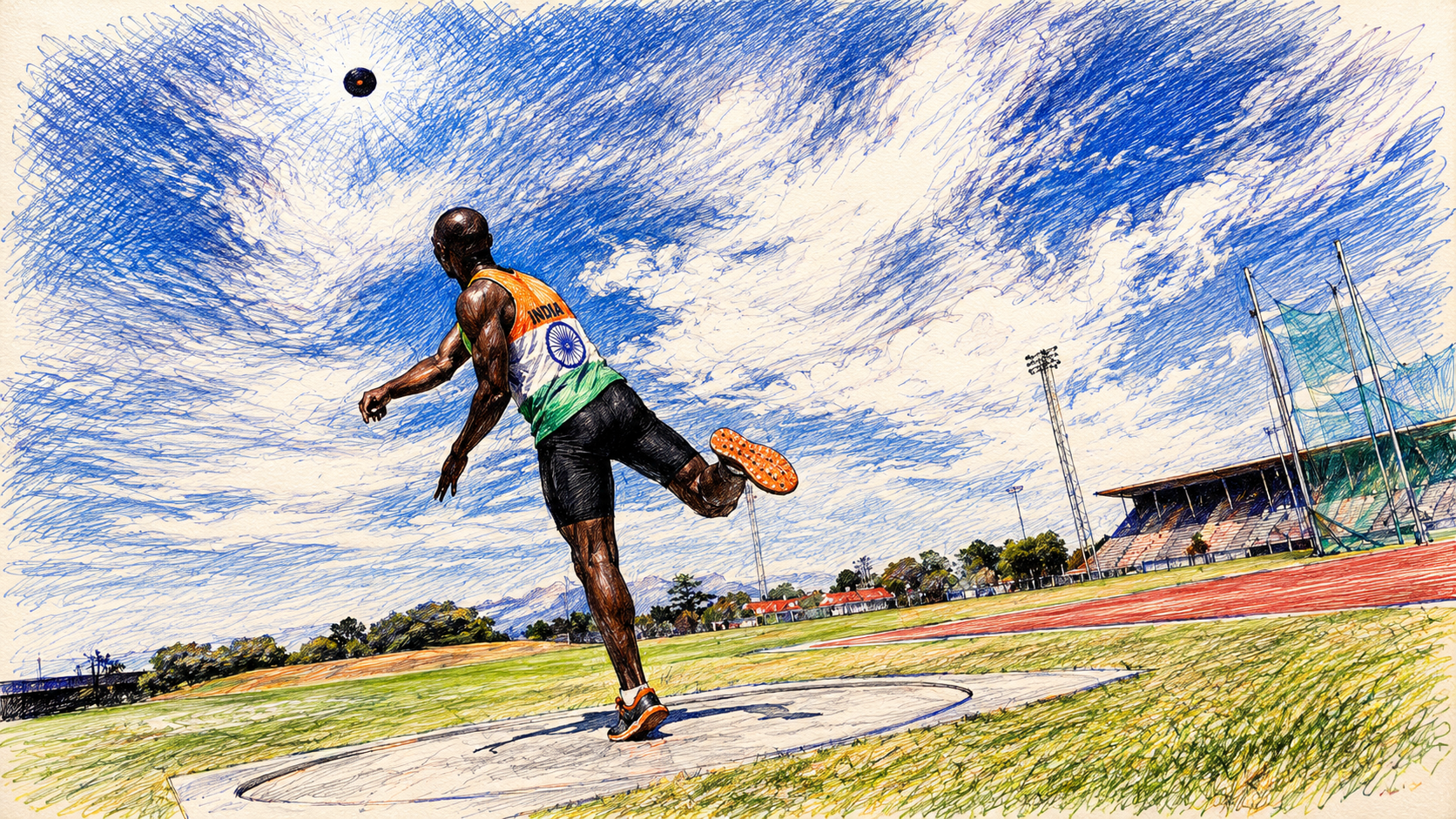
Illustration of an Indian shot put athlete in mid-rotation releasing the shot under a dramatic sky, wearing the tricolor
PUNE — The concrete circle at the Balewadi Stadium measures precisely 2.135 meters in diameter. It is roughly the size of a standard elevator floor. Within this fiercely confined geometry, an athlete has approximately 1.5 seconds to negotiate with gravity. They must transform static human mass into a violent, rotational blur, transferring all of that generated kinetic energy into a 7.26-kilogram sphere of solid brass and iron resting against their neck.
To put that in perspective for the layman: 7.26 kilograms is the weight of a standard adult bowling ball. Now, imagine standing in a phone booth and trying to heave that bowling ball across a two-lane street, and you begin to understand the sheer absurdity of the shot put.
When Samardeep Singh Gill stepped into the ring on a humid Sunday in early June, he was not engaging in a rudimentary test of brute, agrarian strength. He was executing a high-velocity kinetic dance. His winning throw of 18.64 meters at the eighth leg of the Indian Athletics Series was not merely a gold-medal performance; it was a loud, percussive signal that India’s athletic architecture is undergoing a profound paradigm shift.
Historically, the romanticized Indian athlete has been the endurance runner or the lithe sprinter. The nation’s sporting DNA has long been defined by aerobic thresholds, middle-distance suffering, and, more recently, the elastic, whip-like mechanics of the javelin. The heavy throws—shot put, discus, hammer—were often relegated to the shadows, viewed lazily by the public as archaic exhibitions of bulk.
Gill’s 18.64m heave forcefully shatters that misconception. It highlights a quiet but aggressive pivot in Indian athletics toward high-tech, explosive field disciplines, where success is dictated not by the size of the bicep, but by the meticulous, calculated engineering of the human biomechanical system.
The Anatomy of the Kinetic Chain
To the untrained eye in the stadium stands, a shot put throw appears as a grunting, chaotic shove. A large man spins in a circle, yells, and pushes a heavy ball. But strip away the mass, look at the skeleton underneath, and it is actually one of the most complex, perfectly timed movements in all of sports.
The entire objective is release speed. In the fundamental laws of motion governing how far an object flies, the angle of release and the height of the throw matter, but the speed of the implement at the moment it leaves the hand matters exponentially more. If you simply double your raw muscle mass, you might throw the shot slightly further. But if you can double the speed at which you move across the ring, the distance the ball travels squares. Therefore, the shot put is not truly a strength event; it is a speed event disguised in a heavyweight's body.
Gill utilizes the rotational technique—a method that effectively turned shot putters into heavily muscled ballet dancers. To understand how this generates so much power, imagine cracking a heavy leather bullwhip. The movement starts at the handle (the legs and hips) with a relatively slow, powerful pull. That energy travels down the length of the whip (the torso and shoulders), accelerating as it goes, until it reaches the very tip (the arm and wrist), which breaks the sound barrier in a supersonic snap.
Gill’s body is the whip. He begins with his back to the throwing sector. As he sweeps his left leg out to initiate the spin, he is gathering momentum. The true magic, however, happens in the transition at the center of the ring.
Wringing the Towel
As Gill spins and his right foot touches down in the dead center of the concrete circle, his lower body is facing the landing sector, but his upper body remains twisted backward, looking in the opposite direction.
In biomechanics, this is known as separation. For the layman, imagine wringing out a thick, wet towel. You twist the bottom half one way and the top half the other, creating immense, coiled tension in the center. Gill’s torso acts exactly like that twisted towel. His core and back muscles are stretched to their absolute physical limits, acting as a coiled industrial spring.
When his left foot finally plants at the front edge of the ring—an action known as "the block"—that forward momentum comes to a violent, screeching halt. The blocked leg acts like a car slamming into a brick wall. Because the lower body stops instantly, all the rotational energy is violently violently transferred upward. The "towel" unwinds. The hips snap forward, pulling the chest, which pulls the shoulder, which violently launches the arm. The iron ball is pushed, never thrown, leaving the hand in a brutal 0.2-second window.
If Gill’s hips fire a fraction of a second too early, or if his left shoulder opens prematurely, the tension in the towel is lost. The energy bleeds out into the Pune air, and the throw dies. It is a kinetic dance that demands the precision of a watchmaker, performed by a man who weighs over 250 pounds.
The Thirty-Six Centimeter Chasm
An 18.64m throw is an elite mark on the domestic circuit, definitively placing Gill at the pinnacle of Indian heavy throws right now. However, the international tollbooth—the gateway to World Championship finals and Olympic relevancy—is the 19-meter, and ultimately the 20-meter, barrier.
Finding an additional 36 centimeters to crack 19 meters is the most agonizing pursuit in the sport. It cannot be achieved simply by lifting heavier weights in the gym. Elite shot putters can routinely squat a small car, but static strength does not directly translate to the throwing circle.
Think of it like the difference between a massive industrial tow truck and a Formula 1 supercar. The tow truck has immense raw power; it can pull a 10-ton boulder at five miles an hour. The Formula 1 car can't pull a boulder, but it can go from zero to sixty in two seconds. To cross the 19-meter threshold, a shot putter needs to possess the chassis of the tow truck but the engine explosiveness of the Formula 1 car. Coaches call this the Rate of Force Development—the ability to turn on all of your muscle power in the blink of an eye.
To find those elusive 36 centimeters, Gill and the new wave of Indian throwers are turning to sports science. The modern training regimen involves high-speed 3D motion capture, force plates embedded in the throwing circle to measure how hard the athlete pushes into the concrete, and continuous video feedback to measure the precise angle of the throwing elbow. India is finally beginning to build this infrastructure. The shift away from raw, unguided gym-lifting to engineered, scientifically monitored power signifies a long-overdue maturation of the nation's sporting system.
The shot put is a sport of brutal, unyielding honesty. There are no wind-assistance technicalities to debate, no teammates to cover a missed defensive assignment, and no subjective judges to appease. It is just an athlete, a sphere of iron, and gravity.
When Gill’s 18.64m throw landed in the Pune grass, it hit the turf with a heavy, deadened thud that echoed briefly against the stadium seating. It wasn't the glamorous, chest-thumping finish of a 100-meter sprint, nor did it carry the sustained crowd roar of a distance race. But within that single, percussive impact was the proof of a perfectly executed physical equation. India is learning how to build giants, and more importantly, teaching them how to dance.
More From The Field Weekly



Part of Issue 1: The Long Game, published June 18, 2026→