athletics
The Arc of the Hammer: Rural Power and the Physics of Isolation
Anushka Yadav's 67.02m national record, set at eighteen, was built far from any city track — in the rural training grounds where India's heaviest throwing events have always lived.
By Rohan Desai, Track & Field · June 25, 2026 · 6 min read
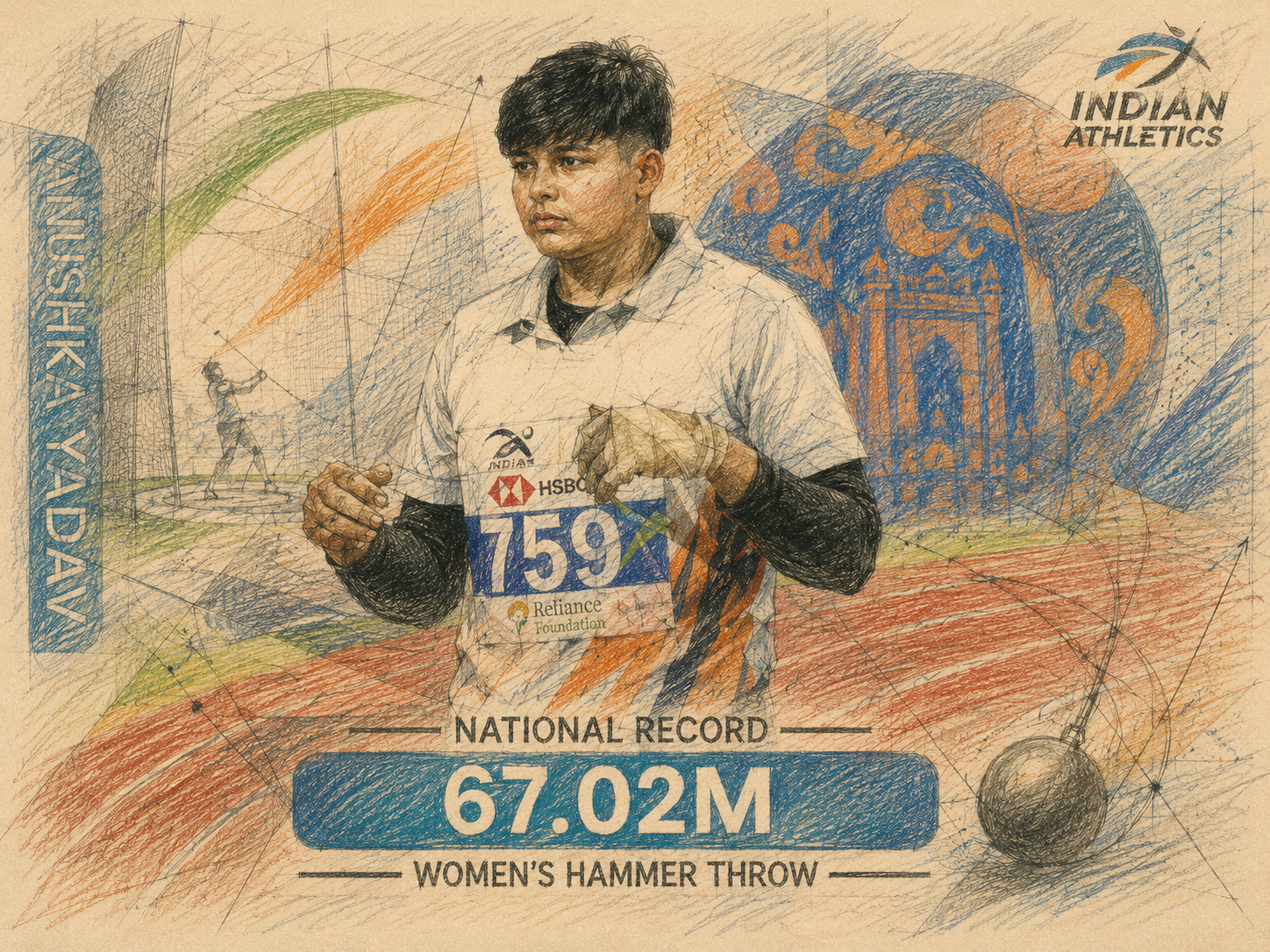
Indian hammer thrower Anushka Yadav in competition kit beside a graphic reading "National Record 67.02M Women's Hammer Throw"
The Violence of the Orbit
The hammer throw is an act of managed catastrophe. It is an industrial, gladiatorial discipline that requires a human being to become the fixed axis of a violent, accelerating orbit. To watch an elite hammer throw is to witness the absolute limits of human connective tissue. When eighteen-year-old Anushka Yadav stepped into the concrete circle at the Inter-State Championships, gripped the rigid handle of the four-kilogram steel ball, and initiated her preliminary winds, she was not merely playing a sport. She was negotiating with the unforgiving laws of physics.
When the hammer struck the earth at 67.02 meters, shattering the senior national record, it sent a seismic tremor through the Indian athletic establishment. A teenager had dismantled a senior benchmark in a discipline that demands decades of neuromuscular conditioning. But the true gravity of Yadav’s achievement lies in the unseen, solitary spaces where this specific brand of kinetic energy is forged.
Unlike the hundred-meter sprint—a linear, digestible spectacle engineered for television and urban stadiums—the hammer throw exists in the extreme periphery of the sporting economy. It is loud. It is dangerous. It requires massive physical acreage and heavily reinforced steel cages. You cannot throw the hammer in a densely packed Mumbai suburb or a pristine Delhi sports complex without risking structural damage. It is a sport of exile, requiring an athlete to embrace deep, geographical isolation. To throw the hammer into the history books, one must first retreat to the fields.
The Sociology of Acreage and Posterior Power
The biomechanical profile of a world-class thrower is rarely cultivated in urban gymnasiums. The modern Indian throwing pipeline—which is slowly becoming a global force—is deeply tethered to the agricultural and rural belts of Haryana, Uttar Pradesh, and Rajasthan. This is not coincidental. It is a matter of foundational physiology and spatial economics.
The physical demands of the hammer throw require a posterior chain—the hamstrings, glutes, erector spinae, and trapezius—of terrifying density. In rural, agrarian environments, the baseline kinetic patterns of lifting, pulling, and leveraging heavy loads create an initial neuromuscular scaffolding that urban, sedentary lifestyles simply do not produce. When this raw, foundational strength is identified and subjected to elite, Eastern Bloc-style periodization, the results are explosive.
But beyond the physiological baseline, there is the sociology of the land itself. An elite thrower needs a cratered field, an iron cage, and total silence to hone the violent timing of the spin. The isolation shapes the athlete. There are no cheering crowds during the thousands of hours required to perfect the heel-toe pivot. There is only the hum of the steel wire cutting through the air, the heavy thud of the implement hitting the dirt, and the grueling, monastic repetition of entering the circle. Yadav’s 67.02-meter mark is a testament to this peripheral economy—a brutalist masterpiece painted far outside the metropolitan gaze.
Constructing the Centrifugal Engine
To comprehend how an eighteen-year-old girl can hurl a solid block of iron 67 meters, one must abandon the illusion that the arms are doing the throwing. The arms in a hammer throw are nothing but biological cables. They must remain completely locked and extended, while the lower body does the actual work of spinning the implement.
The physics here are unforgiving. Keeping a four-kilogram ball spinning in a circle, instead of letting it fly off in a straight line, takes force — and that force doesn't grow gently as the ball speeds up. It grows steeply, so even a small increase in spin speed demands a lot more strength to hold on. To send the hammer 67 meters, Yadav has to release it at close to 28 meters per second — nearly 100 kilometers an hour. Getting it there means that, at the instant of release, the wire is pulling back on her with more than 300 kilograms of force: roughly the weight of a small car, trying to drag her out of the circle.
Yadav is not a heavyweight powerlifter; she cannot muscle 300 kilograms with raw upper-body strength. Instead, she must survive the force through supreme biomechanical counterbalance. As the hammer accelerates through its three or four turns, the centrifugal pull attempts to drag the thrower out of the front of the circle. Yadav counters this by establishing a dynamic, backward-leaning axis. Her hips must sink, her torso must recline, and her center of mass must perfectly oppose the accelerating mass of the steel ball. This is the "double support phase"—the fraction of a second during each spin when both feet are planted, allowing the athlete to aggressively torque the earth and accelerate the implement.
Torsional Elasticity and the Heel-Toe Pivot
The magic of Yadav’s technique lies in her footwork—a dizzying, violent ballet performed inside a 2.135-meter concrete ring. The spin is not a continuous slide; it is a complex series of heel-toe pivots.
During the "single support phase," when one foot is lifted to step into the next rotation, the hammer is effectively pulling the thrower. The implement is in control. The genius of an elite thrower is minimizing this phase. The moment the free foot snaps back down to the concrete, Yadav immediately drives her hips ahead of her shoulders. This creates "separation," or torsional elasticity.
The human core acts as a heavily wound torsion spring. By driving the hips forward while keeping the shoulders violently locked back to trail the hammer, Yadav stretches her obliques and abdominal fascia to their absolute tensile limits. When she hits the final block—planting her left leg with bone-crushing rigidity—that coiled energy snaps. The linear momentum of the spin hits the unyielding wall of the block leg and is instantly transferred up the kinetic chain, whipping the shoulders, down the arms, and into the wire.
At eighteen, Yadav’s ability to maximize this hip-shoulder separation indicates an elite proprioceptive maturity. To maintain this torque while spinning at a frequency that actively disorients the human vestibular system requires neurological rewiring. The inner ear's fluid, designed to keep a human upright, is thrown into chaos during a hammer throw. Yadav’s brain has learned to selectively ignore this biological panic signal, relying entirely on the somatosensory feedback of the concrete beneath her throwing shoes.
The Resonance of the Crater
When the wire slips from the reinforced glove, the violence abruptly ends. The 300 kilograms of tension vanishes in a microsecond. The thrower, previously leaning back against immense invisible pressure, must now fight simply to stay inside the concrete ring, absorbing the residual momentum without fouling.
For nearly three seconds, the four-kilogram steel ball hangs in the sky, tracing a parabolic arc defined entirely by the launch angle and the staggering velocity generated in the solitary isolation of the spin.
Anushka Yadav’s 67.02-meter throw is more than a line in the record books. It is a validation of the periphery. It proves that while urban academies may polish sprinters and jumpers, the heaviest, most brutal expressions of human power are still engineered in the quiet, dusty fields of the heartland. She has mastered an industrial physics that most athletes cannot even comprehend, proving that true power does not seek the spotlight—it simply builds enough kinetic energy to command it.
More From The Field Weekly
Part of Issue 2: The Architecture of Belonging, published June 25, 2026→