athletics
The Calculus of the Baton: Trust, Velocity, and the Illusion of Individual Speed
India's 43.85-second 4x100m relay gold was won less by raw speed than by mastering "free distance" — the invisible meters gained when a baton is passed without either runner breaking stride.
By Rohan Desai, Track & Field · June 25, 2026 · 7 min read
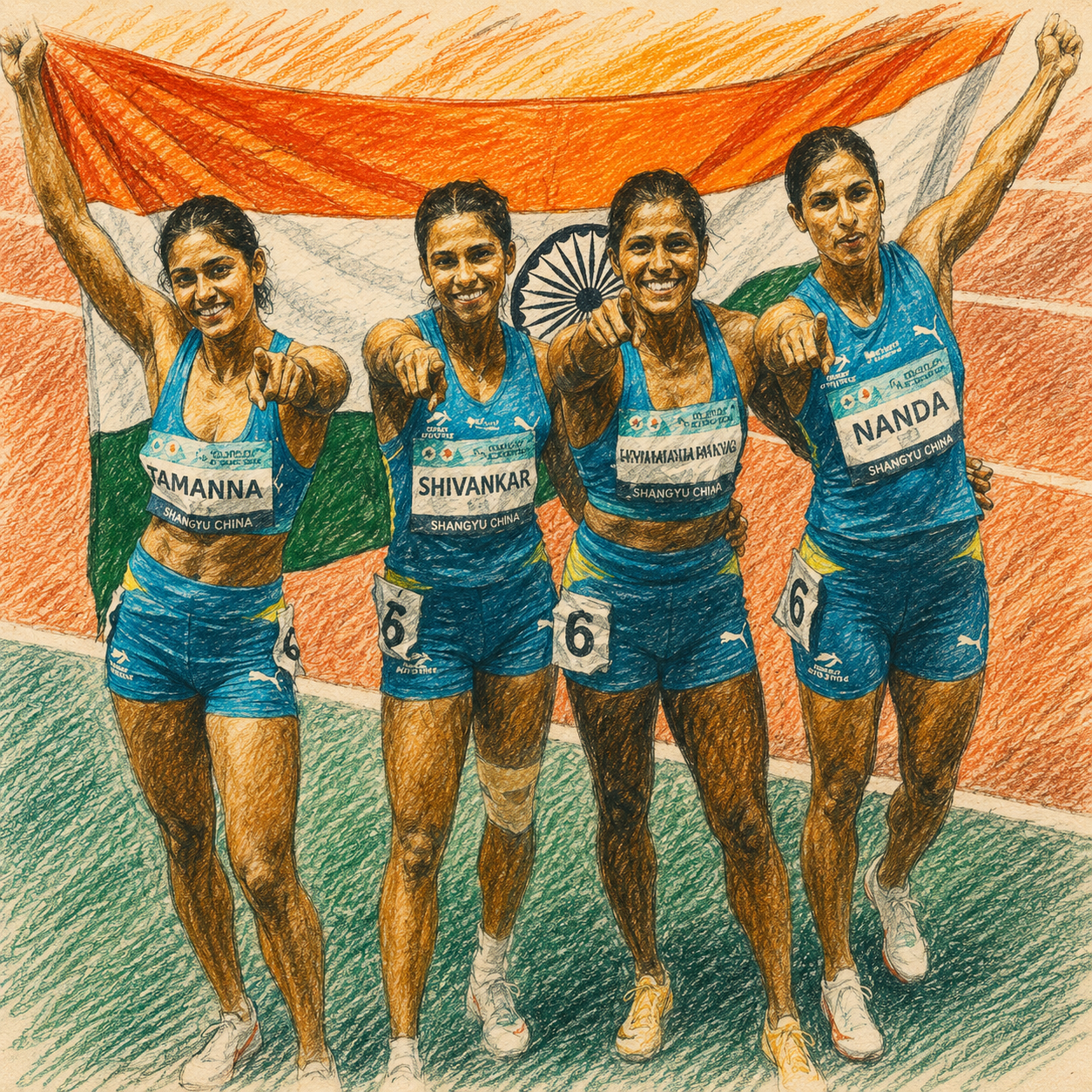
Four Indian women sprinters celebrating a relay gold medal, draped in the Indian flag, with race bibs reading Tamanna, Shivankar, and Nanda
There is a distinct, visceral silence that descends upon an athlete standing in the exchange zone of a 4x100m relay. The stadium may be deafening, the atmospheric pressure thick with nationalistic expectation, but for the outgoing runner, the sensory world collapses into a singular, hyper-focused focal point: a strip of tape on the track. When the incoming runner crosses that piece of tape, a neurological trigger is pulled. The outgoing runner must explode forward, completely blind to the chaotic, high-velocity mass bearing down on them from behind. They must accelerate violently into empty space, extending a hand backward into the void, trusting implicitly that a 50-gram aluminum cylinder will materialize perfectly within their grasp at the exact millisecond their hand opens.
When the Indian women’s 4x100m relay team secured the gold medal at the Asian Relays Championships with a searing time of 43.85 seconds, the triumph was universally celebrated as a testament to the nation’s rising sprinting pedigree. But to view the 4x100m relay merely as four consecutive 100-meter dashes is a fundamental biomechanical fallacy. The 4x100m is arguably the most precarious, complex event in all of track and field. It is a profound exercise in kinematic synchronization, where the illusion of raw individual speed is consistently shattered by the brutal physics of momentum transfer. The Indian team did not win simply because they were the fastest four women on the track; they won because they mastered the absolute architectural perfection of the blind exchange.
The Biomechanics of the Blind Exchange
To deconstruct a 43.85-second race, one must first deconstruct the core engine of the event: the 30-meter exchange zone. Under current World Athletics regulations, teams have exactly 30 meters to transfer the baton. If the baton is passed a millimeter before the line or a millimeter after, the team is disqualified. The objective is terrifyingly simple yet brutally hard to execute: the baton itself must never slow down. It should carry the incoming runner's top speed straight into the outgoing runner's top speed, with no dip in between — which means both runners need to be moving at close to the same speed at the exact moment the baton changes hands.
That's harder than it sounds, because nobody can hold top speed for long. By the time the incoming runner reaches the exchange zone, their legs are already burning and their stride is maxed out — they are, physically, a fraction of a second from slowing down no matter what they do. The outgoing runner has to launch at exactly that moment: just before the incoming runner's speed starts to fall, not after.
The outgoing runner is entirely reliant on the "go mark"—a piece of tape mathematically calculated based on the differential in their acceleration profiles. If the outgoing runner leaves a fraction of a second too early, they will outrun the incoming athlete, stretching the gap beyond the 1.5-meter reach of two extended arms. The kinetic chain breaks. If they leave a fraction of a second too late, the incoming runner will crash into them, compressing the space and forcing a chaotic, decelerated pass that destroys momentum.
The "Free Distance" Anomaly
The true secret of elite relay running lies in a concept known in biomechanical circles as free distance. When a relay is run flawlessly, the total distance covered by the four athletes is actually less than 400 meters.
How is this physical impossibility achieved? Because the baton has length, and humans have arms.
During an optimal exchange, the incoming runner extends their arm fully forward, and the outgoing runner extends their arm fully backward. This creates an invisible bridge of roughly 1.5 to 1.8 meters. During the exact moment of the pass, the baton travels this distance through the air while being held by neither runner’s center of mass. Over three exchanges, a perfectly synchronized team essentially gains 4.5 to 5.5 meters of "free" space—distance where the baton is moving at maximum velocity without any runner having to actually stride through it.
Historically, teams with vastly superior individual 100m times (such as the heavily favored United States men's squads of the past decade) have consistently lost to teams with slower individual runners (like Japan or Great Britain) purely because they failed to maximize free distance. When an exchange is clumsy, athletes run up on each other. The arms compress. The 1.8 meters of free distance shrinks to 0.5 meters. Over three exchanges, a faster team literally forces themselves to run several meters further than a highly synchronized, albeit individually slower, opposing team.
India’s 43.85-second run was a masterclass in exploiting the free distance anomaly. By utilizing an aggressive push-pass technique—where the incoming runner drives the baton straight into the horizontal palm of the outgoing runner—they maximized the spatial geometry between their bodies. They did not just outrun the field; they geometrically shortened the track.
The Anatomy of the Curve
While the straights (legs two and four) are about pure top-end speed, the curves (legs one and three) ask the body to do something else entirely: hold a bend at full sprint.
Sprinting around a curve at close to 36 kilometers an hour, the body wants to fly off it in a straight line — the same way a car wants to skid wide on a corner taken too fast. To stay on the bend, a runner has to lean hard into it on every single stride, fighting that outward pull. And that pull doesn't grow gently as speed increases; it grows steeply, so even a small increase in speed makes the bend dramatically harder to hold. The strain lands unevenly on the body, too — one hip, one set of knee stabilizers, one ankle working harder than the other to keep the runner from drifting wide.
In the Asian Relays final, India's placement of runners on the bends was a critical piece of their systemic success. Leg one requires an explosive start from the blocks directly into the curve, demanding massive power from a standing start. Leg three, however, is arguably the most difficult 100 meters in track. The third runner must receive the baton at high speed, immediately fight that same outward pull through the apex of the curve, and then flawlessly execute a blind pass to the anchor while transitioning from the bend into the final straightaway.
This transition zone is where relays die. As the third runner straightens out of the curve, their whole sense of balance has to reset in an instant — while their brain is also handling a separate, fiddly task: screaming "Stick!" over the roar of the crowd and guiding a small metal tube into a moving target. India's flawless navigation of this specific sector was not an accident of athleticism; it was the result of thousands of hours of practice, training the brain to handle both jobs — staying balanced and passing the baton — at the same time, without either one suffering.
The Architecture of Blind Faith
When the Indian anchor took the baton and tore down the final straightaway to secure the gold, the clock stopped at 43.85. It is a sterile number, devoid of the humanity required to achieve it.
To run the 100m sprint is an act of supreme ego. It is a solitary endeavor where success or failure rests entirely on the individual architecture of your own muscles and the singular fortitude of your own mind. But to run the 4x100m relay is to subjugate the ego completely to the collective. It is a profound psychological leap.
You must stand in a zone of pure chaos, turn your back to a teammate running at 30 kilometers per hour, throw your arm behind you, and trust that they will not let you fail. The margin between a world-class exchange and a dropped baton is roughly a tenth of a second. There is no time to look; there is no time to adjust. There is only the pre-calculated geometry of the tape, the violent explosion of acceleration, and the tether of trust that connects four distinct human engines.
The Indian women's team did not capture the Asian Relays gold simply by outrunning the continent. They captured it because, in the most precarious, unforgiving 30 meters in all of sports, their trust in the calculus of the baton—and in each other—was absolute. They proved that while speed is a biological gift, the seamless transfer of momentum is a higher, more beautiful form of human architecture.
More From The Field Weekly
Part of Issue 2: The Architecture of Belonging, published June 25, 2026→