athletics
The Acceleration Curve: The Anatomy of a Pure Domestic Sprint Double
Animesh Kujur’s 10.21s and 20.59s double in New Delhi confirmed that India’s elusive sprint breakthrough is occurring not on foreign tracks, but on domestic synthetic rubber.
By Rohan Desai, Track & Field · September 24, 2026 · 5 min read

Animesh Kujur exploding out of the blocks at the Jawaharlal Nehru Stadium in New Delhi
NEW DELHI — There is no event in sport that exposes national delusion faster than the men’s hundred-meter sprint.
You can hide administrative incompetence in endurance disciplines behind the poetry of struggle. You can disguise tactical stagnation in field events behind the unpredictability of wind and weather. But the straightaway of an eight-lane synthetic track is an absolute, merciless mirror. A laser timer fires, thirty-four strides are taken, and in ten seconds the electronic board tells you precisely where your country sits in the global hierarchy of human speed.
For half a century, India’s answer on that electronic board was an embarrassing void. While the rest of Asia—first Japan, then China, and recently Thailand—systematically breached the 10.10 and 10.00-second thresholds, Indian sprinting remained stuck in an archaic time loop, celebrating 10.40s domestic titles as if they were continental achievements.
On September 10, at the Jawaharlal Nehru Stadium during the Indian Athletics Final Series, twenty-three-year-old Animesh Kujur permanently redrew the coordinates of Indian sprinting.
Running in wind-legal conditions (+0.4 m/s), Kujur detonated off the blocks to win the 100 meters in 10.21 seconds, edging Gurindervir Singh (10.32s). Ninety minutes later, he returned to the track and demolished the 200-meter field in a scorching 20.59 seconds.
It was the most dominant, technically sophisticated sprint double ever recorded on Indian soil. And its true significance lies not just in the numbers, but in how those numbers were generated.
Overcoming the "Front-Side" Fallacy
To understand Kujur’s breakthrough, one must examine why Indian sprinters have historically hit a hard ceiling at forty meters.
The traditional, deeply flawed dogma of Indian sprint coaching was built on what coaches affectionately termed "pawing the ground." Young athletes were instructed to aggressively kick their heels up toward their glutes and claw backward into the track.
In biomechanical terms, this is catastrophic "back-side mechanics." When an athlete's legs cycle far behind their center of mass, their torso tilts forward, their pelvis drops into an anterior tilt, and their ground contact time skyrockets to over 0.12 seconds per stride. They look like they are working furiously, but they are essentially spinning their wheels in deep sand.
Kujur’s mechanics, developed under high-speed video analysis at the High Performance Centre in Bhubaneswar, represent a radical rejection of this orthodoxy.
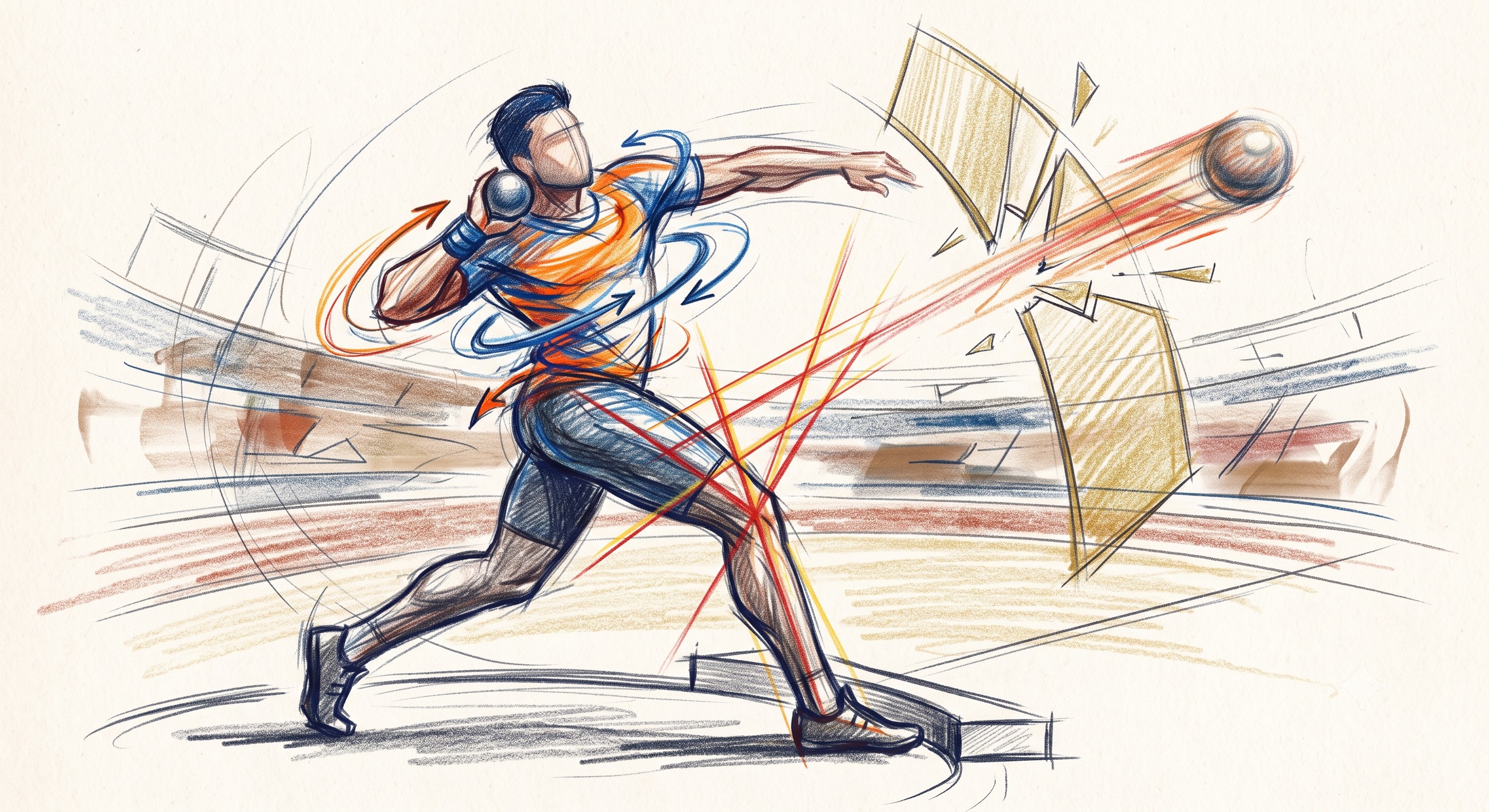
Watch Kujur between the 40-meter and 70-meter mark: his posture is impeccably upright, maintaining a neutral pelvis. He exhibits pure "front-side mechanics." His thighs punch forward and upward, and his foot strikes the ground directly beneath his center of mass with an almost completely stiff ankle joint.
He does not push off the track; he rebounds off it. His lower leg functions like a pogo stick with a titanium spring. Kinematic capture from Delhi showed his average ground contact time at maximum velocity dipped to 0.087 seconds—a figure directly comparable to elite finalists at the European Championships.
The Geometry of the 200m Bend
While his 10.21s in the straight sprint made the headlines, it was Kujur’s 20.59s in the 200 meters that demonstrated world-class spatial engineering.
Running the bend in a 200-meter sprint is one of the most violent geometric challenges in athletics. As a runner accelerates past twenty miles per hour around a curve with a radius of approximately 36.5 meters, centrifugal force attempts to fling their body outward toward the lane line.
Average sprinters fight this force by twisting their shoulders into the curve or leaning their torso sideways from the waist. This lateral torsion ruins stride symmetry: the inside leg takes shorter, chopping strides while the outside leg overstrides to compensate. The runner burns immense metabolic energy just keeping themselves inside the white lines.
Kujur ran the bend in Delhi like a motoGP rider. High-definition overhead footage shows that his lateral lean did not come from his spine; it was initiated entirely from his ankles. His entire body maintained a straight, unified axis, tilted inward at an angle of roughly sixteen degrees.
Because his spine remained neutral, his hips stayed level. His left and right stride frequencies were virtually identical (4.45 strides per second) as he ripped through the apex of the turn.
When he straightened out into the home straight, he did not suffer from the dreaded "curve exit deceleration" that plagues inexperienced runners. He hit the straightaway with full forward momentum, carrying a two-meter cushion over Jishnu Prasad P K and never looking back.
The Domestic Incubator
For years, the standard prescription from Indian sports federations has been to send promising sprinters abroad—to Jamaica, Florida, or Turkey—hoping that proximity to greatness would magically rub off on them.
Kujur’s double is proof that the foreign training junket is no longer a prerequisite. His entire athletic architecture was built domestically. His training program relies on laser timing gates, linear force-velocity profiling, and individualized neuromuscular fatigue monitoring right in Odisha.
This domestic mastery matters because it establishes an internal competitive ecology. When Gurindervir Singh ran 10.32s to push Kujur to the line, and Jishnu Prasad clocked 20.63s in the 200m, they proved that Indian sprinters are finally learning to run fast against each other, rather than chasing lone times in empty stadiums.
The 10.10 Horizon
Animesh Kujur is not yet an Olympic finalist. In the brutal global currency of the 100 meters, 10.21s places you in the conversation for an Asian Games medal, but leaves you in the heats at a World Championship.
The gap between 10.21 and 10.05 cannot be bridged by conditioning; it requires mastering the first fifteen meters out of the starting blocks, where Kujur still leaves roughly four hundredths of a second on the pads due to a slightly delayed hip extension on his second stride.
Yet, for the first time in modern Indian athletics, the path forward is not an elusive mystery shrouded in foreign mythology. The numbers are clear. The physics is understood. In New Delhi, Animesh Kujur proved that human speed is not a geographical birthright—it is an engineering problem waiting to be solved.
More From The Field Weekly
Part of Issue 3: The Friction of Ascent, published September 24, 2026→